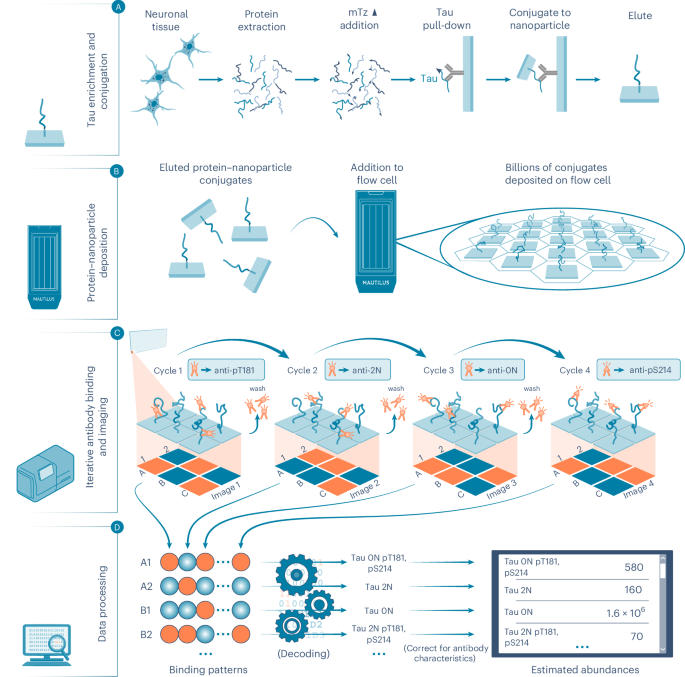
Proteins exist as diverse proteoforms resulting from a combination of genetic variation, alternative splicing and post-translational modifications. Current methods struggle to capture this complexity at the single-molecule level. Here we introduce Iterative Mapping of proteoforms, a method that enables massively parallel interrogation of millions to billions of single-protein molecules through iterative probing with fluorescently labeled antibodies.
We applied Iterative Mapping to tau, a key protein in neurodegenerative diseases, using 12 site-specific antibodies. The tau proteoform assay demonstrates high sensitivity (detecting proteoforms at 0.1% abundance), high reproducibility (median coefficient of variation 3 orders of magnitude), outperforming conventional techniques in resolving closely related proteoform groups. Analysis of relevant biological samples, including organoids, mouse brains and human Alzheimer’s disease samples, revealed 130 distinct tau proteoform groups with as many as six phosphorylation events.
The nonrandom distribution of these phosphorylation events suggests ordered and site-specific modification processes rather than random, stochastic accumulation. Iterative Mapping provides insights into proteoform complexity at the single-molecule level, with implications for understanding protein regulation in neurodegenerative diseases and beyond. Cellular regulation is driven by a complex interplay between protein synthesis, transport, modification and degradation.
One of the most critical aspects of protein-based regulation arises through combinations of genetic polymorphisms, RNA splice variants, proteolytic processing and a multiplicity of post-translational modifications, which collectively generate millions of different proteoforms1. These protein alterations can influence a protein’s structure2, localization3, interactions4, stability5 and enzymatic function4,6. However, outside of a few specific examples7, such as histones8, very little is known about how proteoforms or a diverse set of proteoforms drive cellular function.
Fundamental questions remain, including: ‘Which of the near-infinite number of possible proteoforms exist?’, ‘Is there an order and timing by which a given protein molecule acquires multiple modifications?’ and ‘How do molecularly heterogeneous sets of proteoforms work in concert to drive cell behavior?’ Despite the many unknowns, recent studies have established connections between proteoform alterations and complex biological processes9,10,11. Proteoforms have also been implicated in cancers and neurodegenerative disorders12. As a result, scientists increasingly emphasize the need to study proteins at the proteoform level rather than relying solely on measurements of protein abundance13,14.
The current gap in understanding about the functional impacts of proteoforms arises because their measurement is extremely challenging. Part of this challenge arises from the need to measure proteins without digestion; methods such as bottom-up, shotgun mass spectrometry (MS) typically digest proteins into peptides, thereby disrupting the context required to determine if alterations co-occur. Furthermore, proteoforms are typically present at low abundance, making them difficult to detect directly within complex biological matrices and requiring prefractionation or enrichment15.
Extract — continue reading at the source.