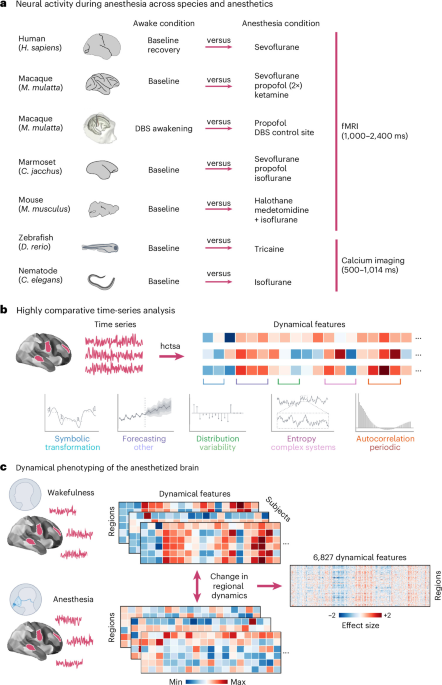
The behavioral effects of anesthetics are highly conserved across species, hinting at shared and fundamental underlying mechanisms. Here we compile a dataset of multiscale neural activity during wakefulness and anesthesia, encompassing human, macaque, marmoset, mouse, zebrafish and nematode. Applying massive feature extraction, we characterize local neural dynamics across >6,000 time-series features.
This reveals a conserved dynamical profile of anesthesia across species, characterized by shorter intrinsic timescales of neural activity and dampened inter-regional synchrony. Deep-brain stimulation of the macaque centromedian thalamus reverses this profile and restores behavioral responsiveness. This conserved dynamical phenotype covaries with conserved transcriptional profiles of excitatory and inhibitory neurotransmission.
Biophysical modeling provides a potential mechanistic link between the macroscale dynamical phenotype of anesthesia and microscale effects of key molecular targets on the timescales of synaptic excitation and inhibition. These analyses reveal a shared neural endpoint of anesthesia: across species and scales, anesthetics induce spatiotemporal isolation of local neural activity. Mapping how neural dynamics support brain function across spatial and temporal scales is a key goal in the neurosciences1,2,3,4.
A prominent paradigm for understanding neural dynamics and their function is to manipulate them through general anesthesia. Anesthetic agents modulate neuronal signaling, altering local and global dynamics, reversibly suppressing the brain’s ability to process information and respond to the external environment. Although different species have evolved unique ways to respond to their specific environments, the behavioral effects of anesthetics (namely, suppression of behavior and inability to interact with the environment) are highly conserved across species, from primates to nematode worms5,6,7,8, hinting at shared and fundamental underlying mechanisms.
Neural changes observed at the macroscale can then be related to downstream effects on cognition and behavior, and to upstream cellular, molecular and synaptic mechanisms at the microscale. Thus, systematically and reversibly perturbing brain function with anesthesia while recording neural activity provides a unique opportunity to understand how the dynamics of local neural activity mediate the links among anatomy, chemoarchitecture and the organism’s functional repertoire. Indeed, numerous imaging studies have reported evidence of changes in neural activity that accompany transitions between wakefulness and anesthesia9,10,11,12,13,14,15,16,17,18,19,20.
However, the current picture of how anesthetics influence neural dynamics remains fragmented and incomplete. On one hand, some reported effects may be specific to a particular species, or a particular anesthetic agent. On the other hand, despite some notable exceptions (for example, refs. 21,22,23,24,25,26), most studies tend to focus on a single species, a single anesthetic and specific hand-picked features of neural activity—such as spectral power, amplitude or temporal entropy.
Extract — continue reading at the source.


