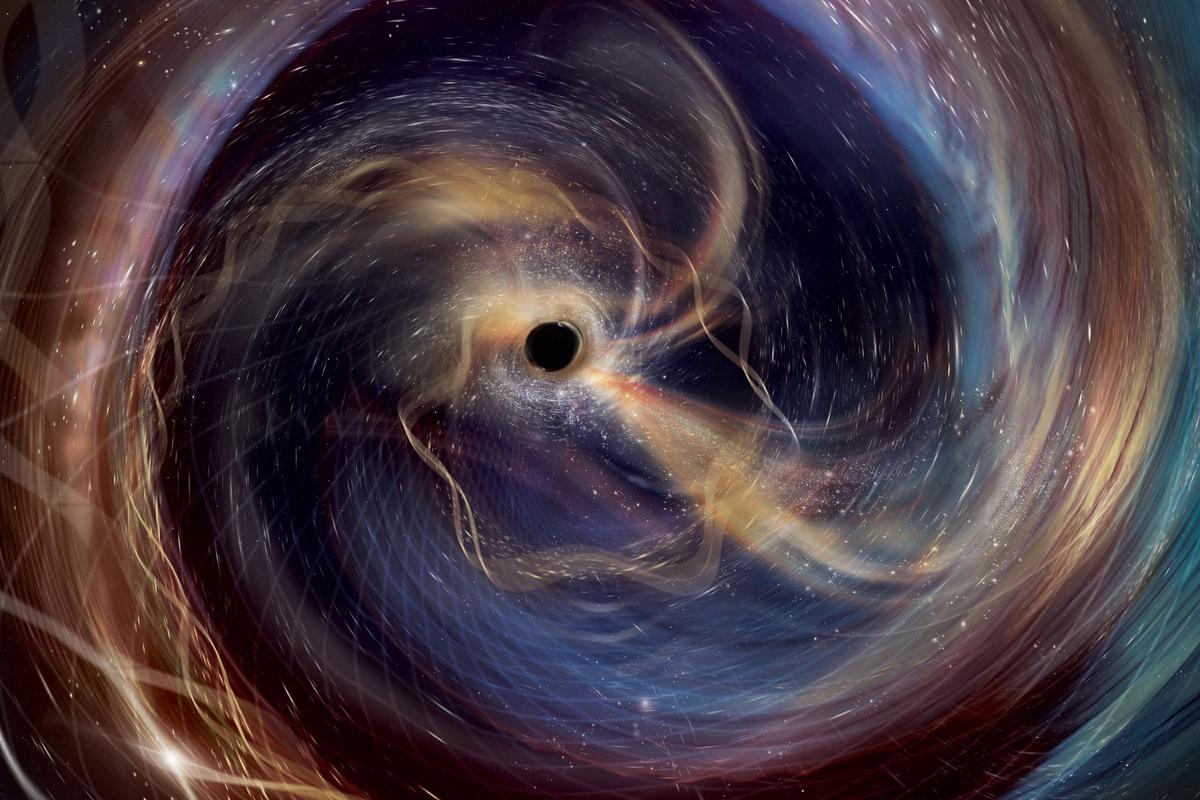
Artist’s impression of GW250114, the celestial collision of two black holes, observed in gravitational waves by the US National Science Foundation LIGO. Courtesy Aurore Simonnet (SSU/EdEon)/LVK/URI/LIGO/CALTECH It is 9 am on a warm July Sunday in Cambridge, as I head towards a café in the city centre. The bells of Great St Mary’s church play the familiar melody of the Cambridge Quarters.
The sound, now often associated with the chimes of Big Ben in London, was first composed here in 1793. The quarters, named for the melody at each quarter-hour, are an immediately recognisable reminder of the passage of time. Each bell produces a note: a wave with a characteristic frequency that travels through the air and reaches our ears.
A hammer strikes the bell, and it oscillates, pushing air molecules back and forth. Those jostling molecules reach our ears and we hear a musical note. Then the bell settles, gives up its energy, and returns to silence.
My research here at the University of Cambridge often brings me back to the ringing of a bell. I don’t study the physics of sound, but I do focus on a remarkably similar process, taking place throughout the Universe. I am interested in another object that also rings: a black hole.
As I sit down with a coffee, I open my laptop to a wavy signal that gradually fades to a flat line. Two black holes have finished merging – a frenzied process of coalescence – leaving an extremely brief wiggle originating from the remnant black hole. Much like the struck bell, this leftover black hole is ringing in a process called ringdown, and it’s consistent across every merger I investigate.
Ringdown allows physicists to test their theories of gravity: did Albert Einstein really have the last word? Just as an off-sounding note from a bell might indicate a design flaw, a discrepancy in the frequencies of a ringing black hole could be the first crack in our understanding of gravity. That’s the scientific rationale for studying ringdown, but what fascinates me equally is what happens next.
Extract — continue reading at the source.



/https://tf-cmsv2-smithsonianmag-media.s3.amazonaws.com/filer_public/a1/be/a1bec4ea-0428-4b24-bd7e-a84a00f9fe79/dsc_4882.jpg)