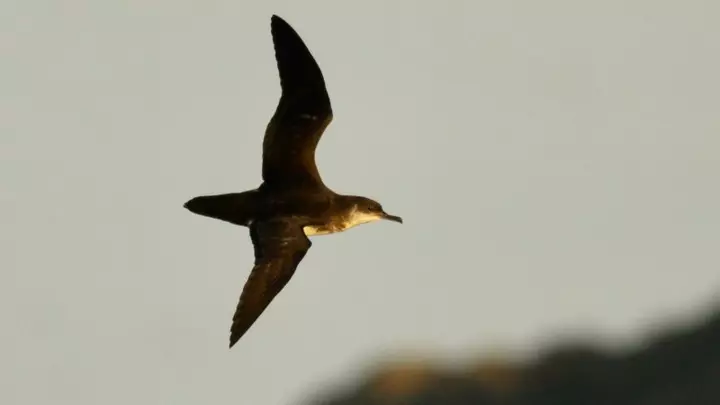
Jet lag isn’t just for travelers hurtling across time zones. Migratory birds may get it, too. Manx shearwaters (Puffinus puffinus) fly fast enough to experience jet lag, researchers report October 29 in Science.
Decades of tracking data from foraging flights revealed that rapid east-west journeys can throw the seabirds’ internal clocks out of sync with local time, causing them to misjudge the sun’s position and veer slightly off course. For animals crossing vast oceans, the sun can help them determine which direction to fly. But because the sun’s position in the sky changes throughout the day, these animals need an internal clock synchronized with natural local sun time to use it as a compass.
This circadian rhythm helps them compensate for the sun’s apparent movement and stay on course. But when birds zip east or west, local time shifts faster than their internal clocks might adjust. Scientists have long predicted that this mismatch could confound the birds’ sun-based compasses, but testing the idea in the wild “has seemed impossible until now,” says Tim Guilford, a biologist at the University of Oxford.
Over 20 years, Guilford and colleagues equipped 1,045 breeding Manx shearwaters with miniature GPS trackers. The trackers logged thousands of trips from United Kingdom breeding colonies to feeding grounds up to 1,000 kilometers away. The team focused on the return journeys, isolating 1,837 continuous homeward flights.
Assuming the seabirds’ internal clocks were synchronized with local time at sunrise, the researchers calculated how flights should throw off their sun compass and compared those predictions with GPS tracking data. The birds veered as expected, by as much as 15 degrees from their intended direction. While following a coastline, the birds should be able to use it as a guide to keep their course.
But they either veered closer to shore or farther out to sea in line with their predicted sun compass errors. The pattern suggests that the birds use the sun compass alongside coastal cues, even when the two point in different directions. The errors are small enough that they add only a few kilometers to the journey, not enough to prevent the Manx shearwaters from finding their way home.
Extract — continue reading at the source.