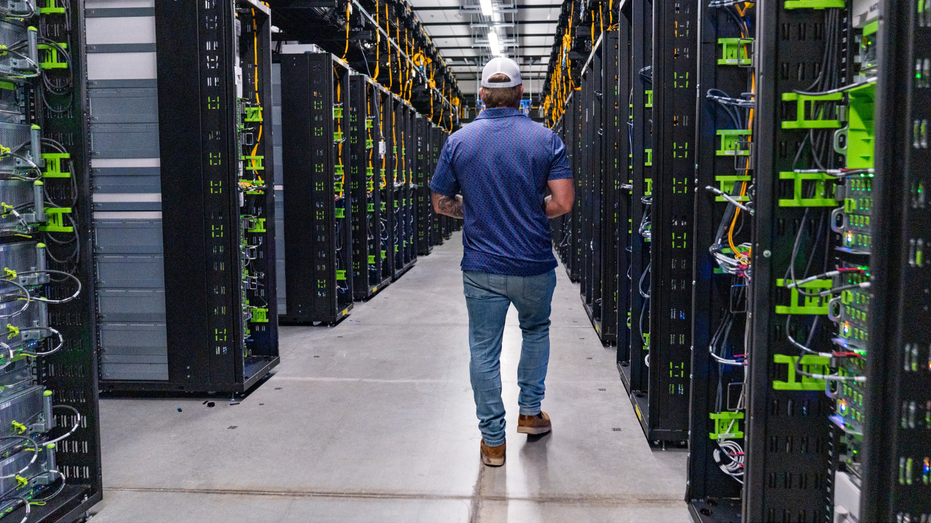
Americans' sensitive information could increasingly be processed overseas if restrictions on artificial intelligence data centers slow construction in the U.S., a data privacy advocate and industry executive warned. The warning comes as states and local governments weigh new restrictions on the rapidly expanding data center industry amid concerns over electricity costs, grid reliability and other impacts on surrounding communities. Brittany Kaiser, CEO of Alpha Compute, said state moratoriums and restrictions on new data centers could push American companies to seek computing capacity in other countries as demand from AI continues to surge.
"One of my top concerns as a top data protection and privacy advocate is that with data center moratoriums being passed in the United States that it will force Americans and American companies to send our data to be processed abroad in other countries," Kaiser told Fox News Digital. "American companies are going to still run their AI," she added. "They're still going to be purchasing data center space in other countries, and it means our sensitive information will be sent abroad and shared with companies and organizations that might not have America's best interests at heart." FROM NETFLIX TO GPS: 10 WAYS THIS HIDDEN TECH INFRASTRUCTURE QUIETLY POWERS MODERN LIFE Data centers are large facilities filled with servers and computing equipment that process, store and transmit information behind many everyday technologies.
They support everything from email, social media and internet searches to online banking, streaming services and AI platforms. As demand for AI grows, companies are building increasingly powerful data centers that require vast amounts of electricity, advanced chips and high-speed network connections. Kaiser said the facilities have become critical infrastructure for the digital economy, making decisions about where they are built and who controls the data they handle a matter of growing economic and national security concern.
Artificial intelligence, however, requires significantly more computing power, fueling a rapid expansion of data center construction across the country. That growth has sparked pushback in some communities over concerns about electricity costs, water consumption, noise and environmental impacts. Kaiser acknowledged those concerns and said companies should be subject to "common sense regulation" designed to protect communities.
"Not all companies are doing it [building data centers] in the same way," she said. "Some are more responsible than others." Kaiser said responsible developments can use closed-loop water cooling systems and generate power independently rather than increasing demand on the existing electrical grid. Alpha Compute, she said, is pursuing projects designed to operate "off-grid, behind the meter," meaning the facilities would generate their own power rather than relying on electricity supplied through the local grid.
Kaiser said that approach is intended to prevent the massive energy demands of data centers from straining existing infrastructure or contributing to higher electricity costs for nearby residents. ONE MONTHLY BILL AMERICANS CAN’T AVOID IS QUIETLY SURGING THANKS TO EMERGING INDUSTRY The company is developing a project in Pennsylvania, where Gov. Josh Shapiro recently imposed new requirements on large data center developments.
Extract — continue reading at the source.