Crows are famously intelligent animals; they use tools, host funerals and remember people’s faces. Past research hints they can even count to four and understand basic geometry. Now, a new study suggests the jet-black birds can make decisions based on visual information incredibly fast—possibly at twice the speed of humans.
The findings, described in the journal Science on October 22, can provide insights into crows’ evolutionary history. Crow brains certainly move “in the fast lane,” study co-author Andreas Nieder, an animal physiologist at the University of Tübingen in Germany, tells the Transmitter’s Sarah Thau. In the study, Nieder and Philipp Schmidbauer, a neuroscientist also at the University of Tübingen, worked with two carrion crows named Iggy and Lemmy.
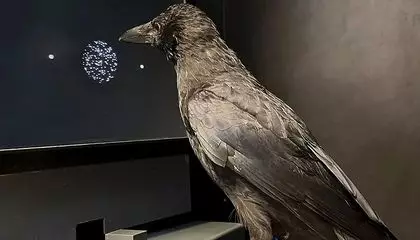
Each would sit in front of a touchscreen showing a cluster of dots in the center. Some dots started moving in one direction—either left or right—while the others shifted randomly as distractors. When the movement began, the birds tapped the left or right side of the screen as fast as possible to indicate which way the associated dots were traveling.
Getting the answer right earned them a tasty treat: a mealworm, Pien Huang reports for NPR’s “All Things Considered.” The birds performed the task thousands of times. In some trials, nearly all the dots moved in concert. Other times, just a tiny fraction did, making it tough for the birds to choose the correct side.
The crows took an average of 235 milliseconds to indicate their correct decision, which is about a fifth of a second. That’s roughly twice as fast as monkeys and humans can do similar tasks without sacrificing accuracy, according to past research. What’s more, “even when the patterns of motion were hard to recognize, the crows’ decisions were still better than random choices,” Schmidbauer says in a statement.
But sometimes they do form flocks, which are famously called murders. As the crows made their lightning-speed decisions, the Nieder and Schmidbauer also recorded activity in the animals’ brains. They specifically monitored nerve cell, or neuronal, activity in the nidopallium caudolaterale, a region similar to the primate prefrontal cortex, which is important for higher-order thinking and decision-making.
Extract — continue reading at the source.