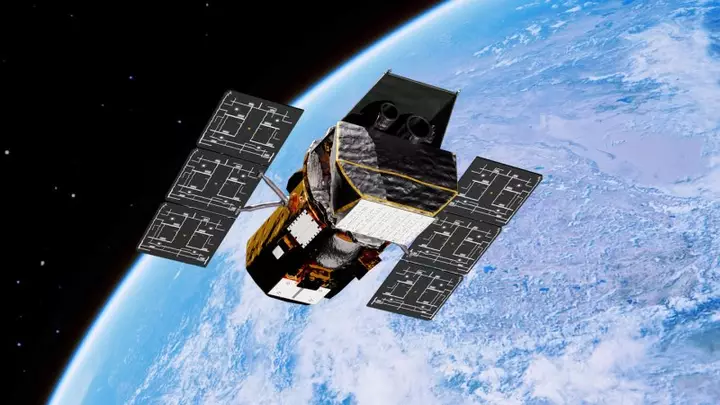
For two decades, when the high-energy universe called, NASA’s Neil Gehrels Swift Observatory has answered. But now, the spacecraft’s science tenure is ending, just when its skills might be more valuable than ever. The Swift spacecraft is falling uncontrollably, destined to burn up in Earth’s atmosphere in just a few days.
The telescope launched in 2004, tailored to reveal the secrets of gamma-ray bursts. These outbursts are the most powerful kind scientists have ever seen, but they often faded before earlier telescopes could respond. Swift took its name from its ability to jump to work when a flash went off.
That talent both illuminated these elusive bursts and made the observatory a cornerstone of modern astronomy for far longer than scientists ever dreamed. We are so fortunate to have had the opportunity to do all the things that we have.” Over the decades, the spacecraft has lost about half its original altitude as it constantly slammed into molecules in the atmosphere. Those minuscule impacts infinitesimally slowed the observatory, pushing it closer to Earth.
The sun’s relatively high activity in recent years has accelerated the process, leaving the spacecraft unable to continue into the 2030s as engineers hoped. A spacecraft commissioned by NASA to loft Swift out of danger launched in early July, but by late August, technical issues made a boost attempt impossible. Swift is doomed — with nothing lined up to replace its unique capabilities.
When scientists dreamed up the Swift mission, the massive energy and elusive nature of gamma-ray bursts made them one of the most tantalizing phenomena out there. Astronomers desperately wanted to understand how they worked. Swift was equipped with three instruments.
Its Burst Alert Telescope gave scientists eyes on gamma-ray emissions from up to half the visible sky, with the resolution to pinpoint where light is coming from. The agile spacecraft could then swing itself and its other instruments — one tuned to X-rays and the other to visible and ultraviolet light — to quickly give scientists a view of a patch of sky across a swath of types of light. It was a combination unlike any observatory before or since.
Extract — continue reading at the source.