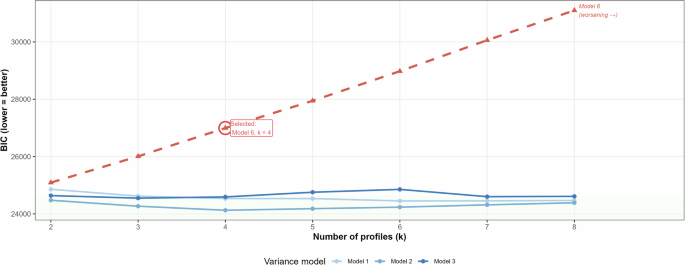
Mild cognitive impairment (MCI) is heterogenous, but classification often overlooks regional variability. Cross-sectional data including 764 individuals from the Biomarker and Cognition study, Singapore, aged >50 years with MCI based on Montreal Cognitive Assessment normative cut-offs were utilised. Latent profile analyses utilising BIC thresholds were applied to demographically adjusted cognitive assessments.
Hierarchical regression evaluated demographic, cardiometabolic, psychological, lifestyle and biomarker predictors of subtypes. Participants had a mean age of 62.72 ± 7.66, 59% females, 14.50 ± 3.44 education years. Four subtypes of MCI emerged; above-average performers (39.0%), multi-domain impaired (19.6%), visuospatial preserved (15.2%), and processing speed preserved (26.2%).
Relative to multi-domain impaired, lower body mass index, alcohol consumption and better quality of life were associated with above-average performers and processing speed preserved membership. Greater grip strength and lower cardiometabolic burden were associated with visuospatial preserved membership. Plasma Aβ40 showed a preliminary, exploratory association with cluster membership.
In conclusion, the study identified four cognitively derived subtypes of MCI, with strong associations observed for lifestyle and psychological factors. Hence, highlighting the potential value of personalised, early approaches to MCI management. Approximately 153 million individuals will be living with dementia by the year 20501.
The Lancet Standing Commission on dementia reports 14 risk factors for dementia, 45% of which are potentially modifiable2. Mild cognitive impairment (MCI) is the stage between normal cognition and dementia and serves as a critical window for disease modification. MCI is characterised by objective impairment of cognition in the absence of obvious functional impairment3, with potential to revert to normal cognitive function.
Findings from community-based cohorts suggest an MCI-to-normal cognition reversion rate of 21.6%–30.9%4,5. Hence, substantial research efforts have been dedicated to the exploration and characterisation of the global epidemiology of MCI. The conventional typification of MCI includes amnestic (aMCI) or non-amnestic MCI (naMCI), with aMCI twice as likely to progress to dementia, as compared to non-amnestic counterparts6.
Extract — continue reading at the source.