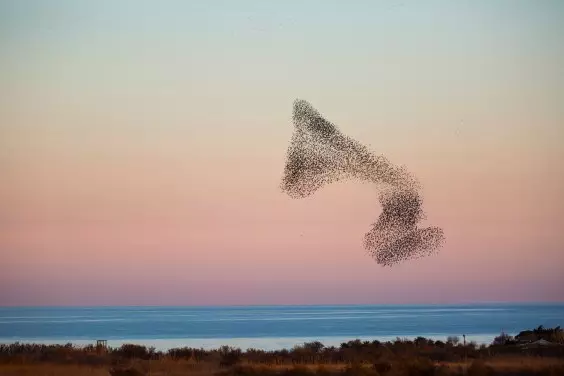
When we tell the storyof how we survived the collapse, we might say: like birds, we learnedto move as one.We grew lighterand lengthened our wings.These are the final lines of “Dear Human at the Edge of Time: A Community Poem.” Assembled from the contributions of 14 different writers across the United States, the poem tells a story about the future that is simultaneously devastating and hopeful.The poem was published in 2023 by Poets for Science in connection with the Fifth National Climate Assessment, which revealed that climate change was already ravaging every region of the United States through rising temperatures, punishing drought, savage wildfires, and deadly storms. READ MORE: Poetry Gives Us PowerIn the three years since the poem was published, the question of how we might collectively survive collapse has become an increasingly pressing one. It turns out, we are not paying enough attention to the birds.
We have not learned to move as one.The data on climate change have told a clear story for a long time, but that story is not getting through. So far, humanity has fallen short of the change needed to keep the Earth on a safe course for future generations.Could art and poetry dedicated to conservation themes help ignite a greater feeling of urgency about our predicament and map a way forward? Poets for Science, forged in the turmoil of the first Trump administration, has made this call to action one of its missions.The group is uniting poets and scientists in collaborations that aim to make the science of conservation both felt viscerally and understood intellectually.
It’s also inviting the public to participate with verse or other creative work of their own. The poem “Dear Human” lives on an interactive platform that allows anyone to contribute. Writers can respond to poems published in an award-winning climate poetry anthology, add to a digital gallery of climate art, or build their own “found poems” out of text borrowed from the Fifth National Climate Assessment.
In just a couple of weeks, Poets for Science will hold its first in-person gathering, where scientists and poets will meet across three days to explore the connections between their disciplines, and ways to inspire the civic imagination. That meeting is sponsored by the Wick Poetry Center at Kent State University in Ohio, which Hassler directs. I spoke with Hassler about how poetry is like lichen and how it can help make science meaningful while inspiring collective action.There have been many periods across history when art and science were closely aligned.
Artists were scientists and scientists were artists. Nobel laureate neuroscientist Eric Kandel beautifully describes such a period in Vienna at the turn of the 20th century in his book The Age of Insight. The Renaissance, too, was packed with figures who merged artistic mastery with scientific inquiry.
But during the scientific revolution, art and science split. There was this intellectual divide. Today it seems like the pendulum might be swinging back the other way.
Extract — continue reading at the source.