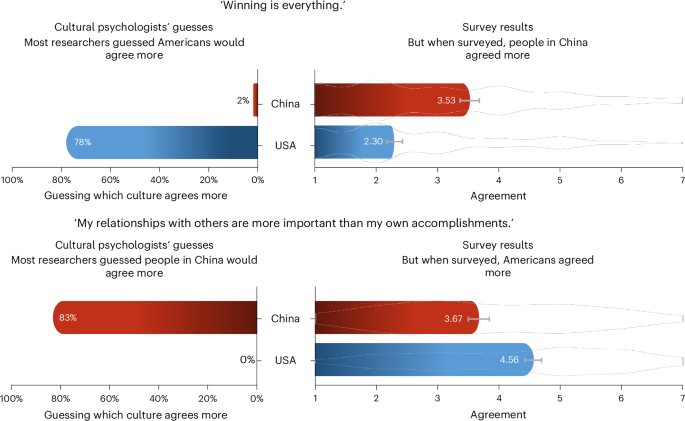
Experts widely agree that East Asian cultures are more collectivistic than Western cultures. Yet 76 survey studies found no reliable difference. Our explanation is that the most-used surveys are contaminated with ‘warm fuzzy’ items, which describe warmth and prosociality towards everyone near and far.
We argue that collectivism is better understood as ‘responsibilism’, which emphasizes responsibilities in close relationships. A survey found that many cultural psychologists expect collectivistic cultures to agree with warm fuzzy items. Then we developed a responsibilism scale and tested 12,247 people in 100 cultures.
Results showed large cultural differences (d = 3.98 [2.50, 5.43]) that were previously obscured by flawed measurement. Responsibilism predicted differences across societies (such as family ties and corruption) and individuals (social class and politics) that most earlier scales missed. This study offers a solution to previous puzzling findings by distinguishing warm fuzzy prosociality from responsibilism and introducing a scale with stronger predictive validity.
In the 1990s, there was a boom in research on culture. The spark was a 1991 paper arguing that East Asian cultures are interdependent and Western cultures are independent1. After the paper came out, it accumulated over 35,000 citations and the percentage of studies on collectivism tripled (Supplementary Fig. 17).
Researchers had been studying collectivism for decades, but this paper inspired a flurry of self-report surveys to measure differences in collectivism2,3. The effort to measure collectivism has the potential to benefit many fields. Researchers in sociology, history, political science and economics have all linked collectivism to differences across societies and across history4,5,6,7,8.
If we can create a tool to measure collectivism reliably, it could be useful across the social sciences. With these new measures, researchers got to work. Researchers gave the scales to people in East Asia and the West.
Extract — continue reading at the source.


