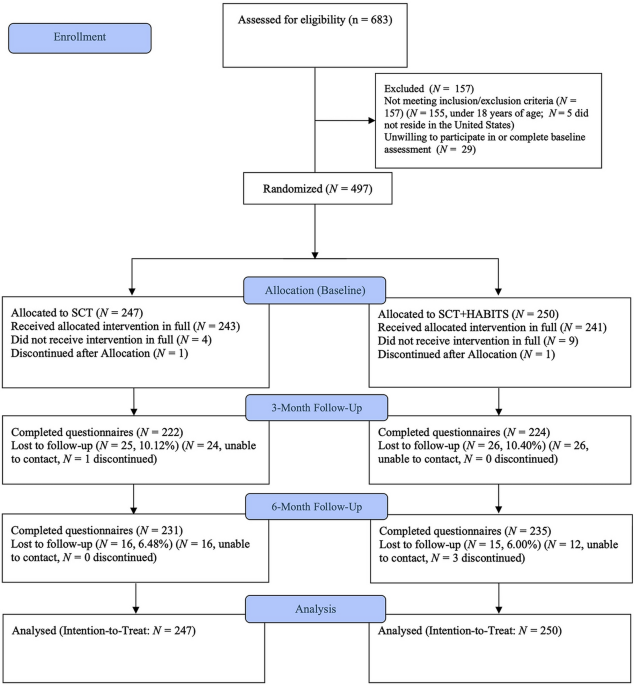
This preregistered study tested a 15-minute, self-guided, online, single-session intervention designed to promote habit formation of self-compassionate touch micropractice (≤ 20 s/day). A U.S. national adult sample (N = 497) was randomized to self-compassionate touch with habit formation tools (SCT+HABITS) or self-compassionate touch alone (SCT)—and assessed at baseline, month-3, and month-6. Relative to SCT, SCT+HABITS showed greater baseline-to-3-month and baseline-to-6-month increases in practice frequency, practice automaticity (habit formation), self-compassion, and self-compassion automaticity, as well as greater baseline-to-6-month reductions in symptoms of psychopathology (mental health symptoms).
Baseline-to-3-month increases in practice automaticity mediated baseline-to-6-month effects, accounting for approximately 40–83% of the total group effects. Both interventions demonstrated high acceptability. Their outcomes did not differ by racialized identity.
Findings highlight the role of habit formation in promoting positive outcomes of self-compassionate touch micropractice, and perhaps well-being practices more broadly. The scalability and adaptability of SCT+HABITS highlight a promising model for advancing efficient, effective, user-friendly interventions. Trial registration ClinicalTrials.gov Identifier: NCT05866718, registered 23/05/2023.
Up to 40% of premature deaths and health problems are preventable through the habitual practice of health behaviors1,2. Despite the importance of healthy habits1,2, efforts to build them more often fail than flourish3,4. Well-being practices are a category of health behaviors defined here as “practical methods to bring about a state of enduring well-being or inner flourishing […] by voluntarily cultivating healthy habits of mind (p. 121)”5.
Emotional well-being, a multidimensional construct encompassing emotional states, life satisfaction, purpose, and positive functioning6, is a core target of such practices. Well-being practices can promote a range of psychological benefits7,8, yet they often fail to endure as daily habits9,10. Because practice frequency is a key contributor to the benefits of well-being practices10,11,12,13, this study seeks to test the hypothesis that adding tools to promote habit formation will improve outcomes of well-being interventions by promoting practice habits14.
This study focused on self-compassion practice. This subset of well-being practices aims to cultivate the five core elements of self-compassion: acknowledging suffering, seeing suffering as a universal human experience, emotionally connecting with the suffering, being able to tolerate uncomfortable feelings, and being motivated to alleviate one’s suffering15,16. Self-compassion practice has a range of documented benefits, including reducing stress and symptoms of psychopathology7,10.
Extract — continue reading at the source.


