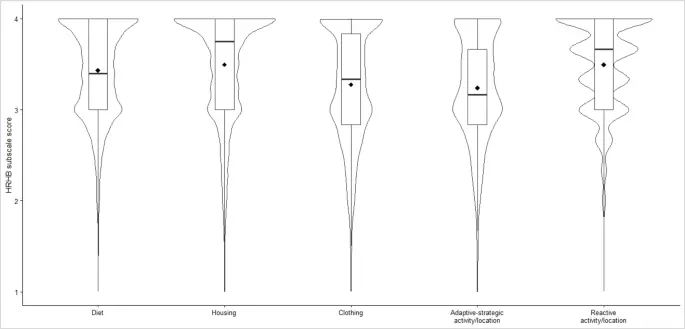
Heat is an escalating global health risk, yet how populations adapt behaviorally remains poorly understood. We developed and psychometrically evaluated a novel instrument to assess heat-related health behavior (HRHB) across domains of everyday life and along a continuum from reactive to anticipatory responses in a large population-based sample in Germany (N = 3,351). Factor analyses supported a multidimensional structure capturing both domain-specific (diet, housing, clothing, activity/change of location) and temporal adaptations.
HRHB showed good reliability and moderate associations with heat-related health literacy and knowledge, indicating related but distinct constructs. Higher levels of reported behavior were associated with greater symptom burden, consistent with behavior being partly driven by experienced heat strain. HRHB explained additional variance in symptoms beyond sociodemographic and cognitive factors, supporting its incremental validity.
These findings identify behavioral adaptation as a distinct and measurable dimension of population-level heat resilience, enabling improved identification of vulnerable groups and more targeted public health interventions. Heat is no longer a future threat for health; it is already shaping everyday life in Europe. Days with temperatures exceeding 30 °C are no longer exceptional events but have become a recurrent phenomenon and are projected to increase further as global warming continues1,2,3.
Heat is not only an environmental challenge but a pervasive stressor that affects individual well-being and performance in daily life4,5,6. At the societal level, its consequences are substantial: heat contributes to rising healthcare costs4,7 economic losses8,9, and tens of thousands of excess deaths each year across Europe10,11,12. While efforts to limit further temperature increases remain essential, current projections suggest that, at best, warming can be slowed rather than prevented1,13.
Against this background, adapting to heat becomes a central public health challenge. In addition to structural and policy-level responses, this places increasing importance on individual behavior14. Individual health behaviors in general have been in the focus of intervention research for a long time; they have been applied to numerous domains (e.g. physical activity, dietary behavior, alcohol consumption, sexual health) and studied using a variety of methods15,16,17.
In addition, they were linked to cognitive constructs such as knowledge and literacy and their determinants18. In this specific case, heat-related health behavior (HRHB) refers to actions undertaken by individuals in everyday life to prevent, reduce, or cope with adverse health effects of heat. The role of research and science in promoting specifically HRHB can be to propose and evaluate intervention strategies.
Extract — continue reading at the source.