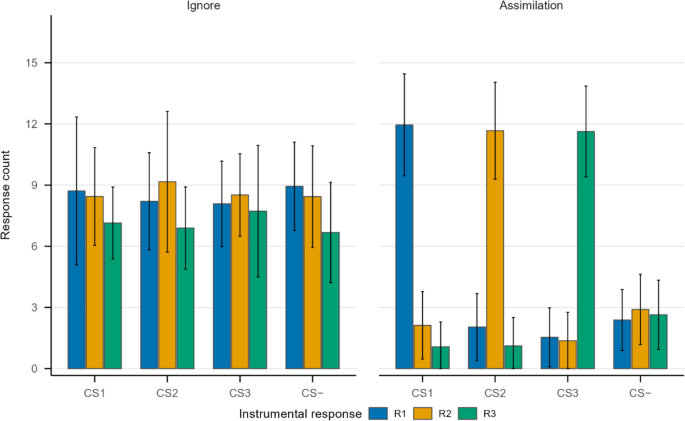
In outcome-selective Pavlovian-to-instrumental transfer (PIT), reward-related cues selectively energize instrumental responding for associated outcomes. In humans, this effect has been attributed both to automatic associative processes and to cognitive inferences about which rewards are available in the presence of a cue. The present research examined whether outcome-selective PIT is influenced by manipulations that discourage such inferences.
Across three experiments using a stock-market scenario with monetary rewards, participants learned Pavlovian cue–outcome relations and instrumental response–outcome contingencies before a transfer test. Experiment 1 established an outcome-selective PIT effect, which was substantially larger among participants reporting strategic use of the cues. Experiment 2 showed that instructing participants to forget the Pavlovian relations after an ostensible software error significantly reduced this effect.
Experiment 3 showed that a concurrent working-memory load during the transfer test also attenuated PIT. However, a small effect persisted under the combined manipulations. Together, these findings indicate that outcome-selective PIT is modulated by cognitive reward expectancies and by beliefs about cue relevance.
The residual transfer is not readily explained by experimenter demand, which here worked against cue-based responding. Cue reactivity therefore appears to rest on reward expectations that persist even when they are false and have been explicitly disavowed. Pavlovian reward signals can exert a strong influence on instrumental behavior, biasing action selection and enhancing response vigor in both adaptive and maladaptive ways1,2,3.
These Pavlovian–instrumental interactions have often been explained by associative processes that guide reward-seeking behavior relatively automatically4, 5. However, alternative accounts have emphasized the contribution of cognitively mediated inferences about reward availability in humans6. Thus, it remains an open question whether these phenomena are driven primarily by automatic associative processes or cognitively mediated inferences.
Distinguishing between these accounts requires a closer look at the experimental paradigms used to investigate Pavlovian–instrumental interactions, particularly the Pavlovian-to-instrumental transfer (PIT) procedure. A typical reward-based PIT paradigm comprises three phases: (1) a Pavlovian learning phase, in which participants learn that conditioned stimuli (CS+) signal the delivery of specific rewards (e.g., tokens); (2) an instrumental learning phase, in which participants learn to obtain specific rewards through their own actions (e.g., by pressing specific response keys); and (3) a transfer test, in which participants can freely select among instrumental responses during presentations of Pavlovian cues without explicit reward delivery (i.e., under nominal extinction). A widely replicated finding is the outcome-selective PIT effect: Instrumental responding for a specific reward is selectively enhanced in the presence of the CS+ associated with that reward, relative to presentations of a CS+ paired with a different reward or a CS– associated with no reward (for reviews, see1,6,7).
Extract — continue reading at the source.