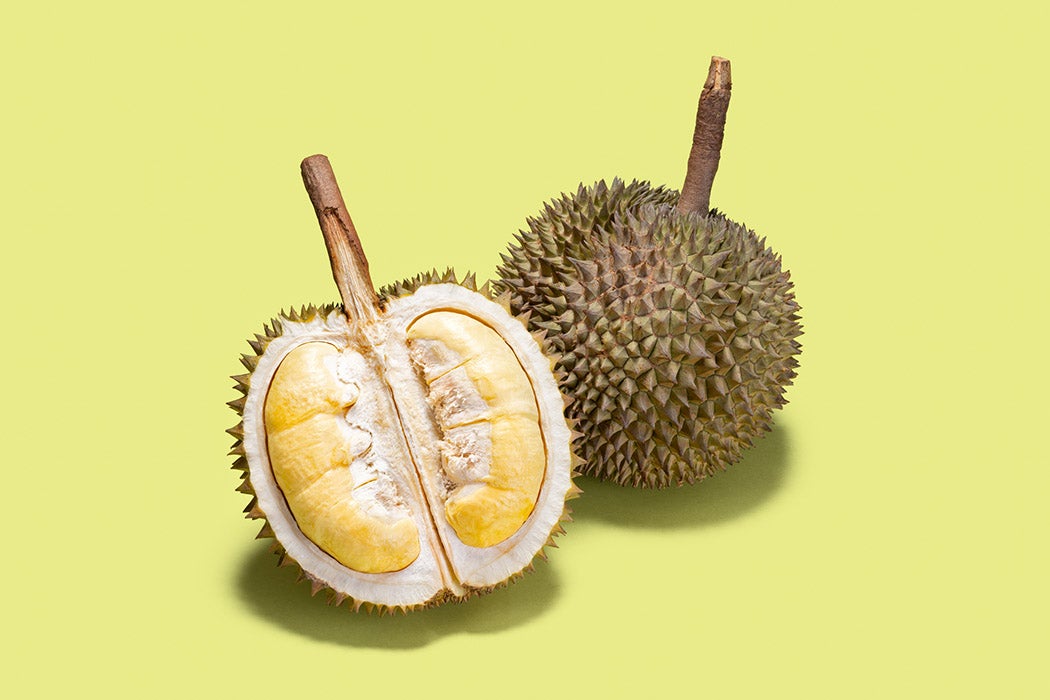
In 2019, 550 students evacuated the University of Canberra’s library because of one fruit: durian. Its sulfuric odor had been mistaken for a gas leak, a common occurrence that has grounded planes and baffled fire departments worldwide. Known colloquially as the “King of the Fruits,” durian commands attention with its pungent scent and spiky husk.
Despite these seemingly unsavory qualities, durian’s sweet flesh has created a multibillion-dollar consumer market that fuels economic growth in countries like Vietnam, Malaysia, Cambodia, and Thailand. Central to Southeast Asia’s ecological systems, economic development, and sociopolitical organization, durian’s overpowering presence shapes local customs and mobilizes transnational supply chains, testifying to the sensorial hold that plants have over us. For those unacquainted with the peculiar odor, taste, and texture of durian, American botanist Francis Ramaley’s 1905 account offers a helpful starting point.
He describes durian’s smell as a “rare combination of vile odors”: “first one thinks of rotten eggs, then of sewer gas and garlic and finally he gives up any attempt at a classification of the different smells.” By contrast, in one of the most vehement defenses of the fruit, British naturalist and “confirmed Durian eater” Alfred Russel Wallace waxes lyrical in his 1869 travelogue The Malay Archipelago: A rich butter-like custard highly flavoured with almonds gives the best general idea of it, but intermingled with it come wafts of flavour that call to mind cream-cheese, onion-sauce, brown sherry, and other incongruities. Then there is a rich glutinous smoothness in the pulp which nothing else possesses, but which adds to its delicacy. It is neither acid, nor sweet, nor juicy; yet one feels the want of none of these qualities, for it is perfect as it is. […] In fact to eat Durians is a new sensation, worth a voyage to the East to experience.
These contrasting colonial accounts show that durian was just as polarizing then as it is today. More importantly, Ramaley and Wallace both recognized durian’s powerful effect on the senses and the intensely visceral responses it evoked, whether expressed in terms of disgust or desire. It is precisely this complexity and intensity that characterizes durian, a fruit whose importance in Southeast Asia goes beyond simple binaries like the detestable and the delightful, the economic and the cultural, or the local and the transnational.
Although the Durio genus has more than 28 recognized species, durian (Durio zibethinus) is the most commonly cultivated species for human consumption. At least 200 cultivars have been developed through human selection, and the plant has spread from its native Borneo, Sumatra, and Peninsular Malaysia to Thailand, Cambodia, and Vietnam. The characteristic smell of durian has been attributed to a combination of many different scent molecules, but scientists still struggle to pin down the exact compounds responsible, even with advanced chemical analysis techniques.
The strong notes of fruity esters and sulphurous compounds are thought to serve as an important biological mechanism for attracting animals to consume the fruit and disperse its seeds. Still, wild durians are relatively scarce because the fruit’s large seeds, tough husks, and thorny exterior mean that only large terrestrial mammals like elephants and macaques can participate in its seed dispersal. As a result, durian is now primarily found in human-managed landscapes, where it is grown semi-wild for household consumption or on commercial plantations.
Extract — continue reading at the source.