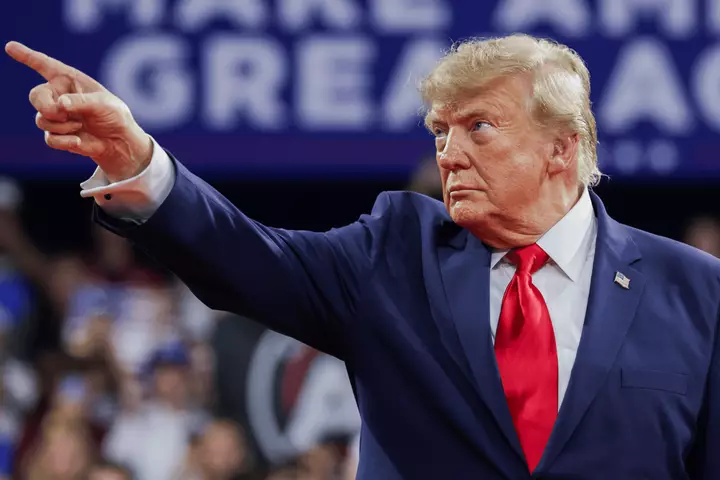
President Donald Trump’s Midwest approval stands at 38 percent against 57 percent disapproval in an October New York Times/Siena poll, leaving him 19 points underwater with this group for the first time in his second term. The president’s party usually loses ground in midterm elections, while Republicans are defending their congressional majorities on November 3. Senate candidates in competitive Midwestern races such as Michigan, Ohio, Iowa and Kansas must now persuade dissatisfied voters to judge them separately from the White House.
Political scientists and Republican strategists told Newsweek that economic pressure was damaging Trump across the Midwest, although GOP figures said strong candidates could still distance themselves from the president. Costas Panagopoulos, a distinguished political science professor at Northeastern University, told Newsweek that Trump’s policies have hit Midwestern farmers and working-class communities “especially hard.” Brittany Martinez, a Republican strategist and former aide to House Speaker Kevin McCarthy, said Republicans were “paying for the gap between Trump’s economic promises and what voters are experiencing.” She cautioned against treating one regional cross-tab as a forecast for four states or “proof of a decline without comparable earlier data,” but added: “It’s a warning Republicans should take seriously.” Meanwhile, Thad Kousser, a political science professor at UC San Diego, said the result was consistent with other surveys in the region, increasing his confidence that it reflects “a significant public opinion trend.” The survey found voters nationally unhappy with Trump’s handling of living costs, gas prices and the war in Iran, pressures that can feel particularly immediate to households and agricultural businesses reliant on fuel. Democrats need a net gain of four seats to take the Senate, making late movement across several competitive states potentially decisive.
The New York Times/Siena survey questioned 3,494 voters nationwide from October 12 to 19 and carried an overall sampling error of plus or minus 1.9 percentage points. Its Midwest result is less precise because it comes from a smaller regional subgroup. The published data does not provide a sample size or separate margin of error for that group, meaning Trump’s 19-point deficit should be viewed as a directional signal rather than a prediction.
Democrats also held a nine-point advantage on the generic House ballot among the poll’s Midwestern respondents. Republican strategists told Newsweek, however, that strong local candidates could outperform Trump by persuading voters to split their tickets. He has placed himself at the center of that effort through a nationwide campaign blitz, urging supporters to vote on November 3 as though his name were on the ballot.
Panagopoulos connected the erosion to tariffs and other administration policies affecting farmers alongside struggling middle- and working-class communities. Healthcare is another source of apprehension, Panagopoulos said, as residents anticipate losing support or encounter cutbacks and rural hospital closures. Kousser pointed to higher fuel and fertilizer costs following the Iran war as real-world burdens in Iowa and Kansas, two states that backed Trump strongly in 2024.
Closely contested races in traditionally Republican states such as Kansas, Iowa, and Nebraska are “incredibly rare”, Kousser added, arguing that GOP candidates may need to outperform Trump to win because his “unpopularity is the only reason we are now talking about these states as battlegrounds.” The national portion of the Times/Siena poll reinforces the pocketbook concern: 69 percent disapproved of Trump’s handling of living costs, while 73 percent disapproved of his record on gas prices. Thomas also identified “cost-of-living frustration” as Trump’s central vulnerability, but said late advertising from MAGA Inc. and affiliated groups was emphasizing border enforcement, energy production and the administration’s efforts to reduce inflation. He argued that contrasting that record with Democratic proposals on spending and regulation could reach undecided voters and low-propensity Republicans.
Extract — continue reading at the source.