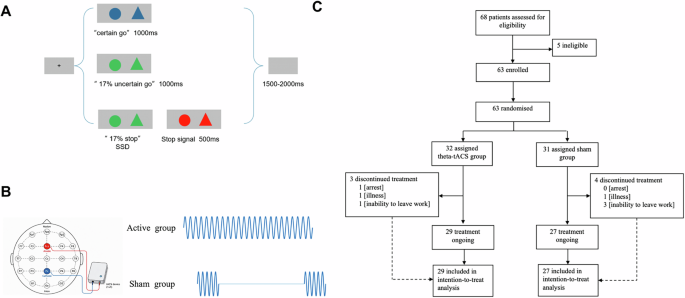
Methamphetamine use disorder is associated with significant cognitive control deficits, and effective treatments remain limited. Frontal midline theta (FM-theta) oscillations are implicated in cognitive control, but whether theta-frequency transcranial alternating current stimulation (theta-tACS) can improve proactive and reactive control in this population remains unclear. This study initially enrolled 68 male participants diagnosed with methamphetamine use disorder according to DSM-5 criteria.
Among them, 56 individuals completed all study procedures and were included in the final analysis. Cognitive control was assessed using a conditional stop-signal task with concurrent EEG recording. The stimulation protocol comprised 15 consecutive daily sessions, during which participants received either active theta-tACS or sham stimulation (2 mA, FCz - Pz montage) in a double-blind design.
Following the 15-day theta-tACS stimulation, patients exhibited a significant improvement in preparation cost (p = 0.001) and an increased inhibition rate (p = 0.003). EEG analyses showed that tACS selectively enhanced late-stage proactive control-related theta power (p = 0.026), without significantly modulating theta activity associated with reactive control (p > 0.05). Importantly, the tACS stimulation restored the functional coupling between FM-theta activity and proactive control performance (p = 0.04), and baseline late-stage theta power at T0 positively predicted improvement in preparation cost (ΔT1 - T0) during proactive control (p = 0.01).
Finally, a mediation analysis revealed that the tACS-induced improvement in inhibition rate was mediated by the enhanced preparation cost. These findings suggested theta-tACS enhances proactive control by restoring the functional coupling between FM-theta activity and proactive control, which in turn triggers a cascading improvement in reactive control. This is a preview of subscription content, access via your institution Receive 12 print issues and online access Prices may be subject to local taxes which are calculated during checkout The data that support the findings of this study are available from the corresponding author upon reasonable request.
Shoptaw S, King WD, Landstrom E, Bholat MA, Heinzerling K, Victorianne GD et al. Public health issues surrounding methamphetamine dependence. Methamphetamine addiction: Basic science to treatment 2009: 143-56.
Approaches to the development of medications for the treatment of methamphetamine dependence. Addiction. 2007;102(Suppl 1):96–106. Brensilver M, Heinzerling KG, Shoptaw S.
Extract — continue reading at the source.