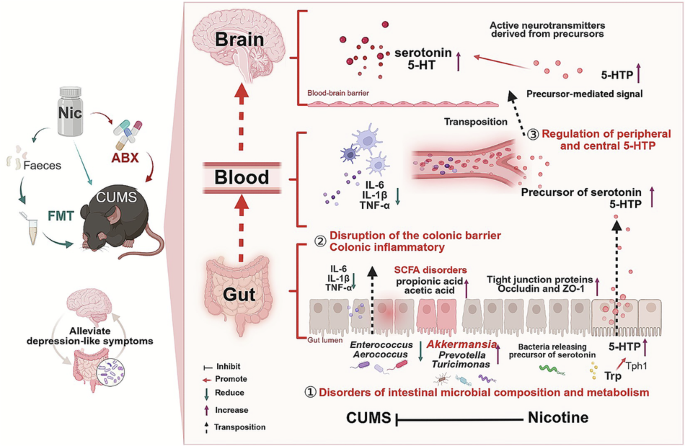
Major depressive disorder is a heterogeneous neuropsychiatric disorder in which serotonin-related pathways remain important pharmacological targets. Nicotine has been reported to exert antidepressant-like effects, yet whether the gut microbiota contributes to these effects remains unclear. Here, we found that sustained-release nicotine (0.2 mg/kg/d) improved depression-like behavioral measures in a chronic unpredictable mild stress (CUMS) mouse model.
Nicotine treatment was also associated with improved intestinal barrier integrity, reduced colonic inflammation, partially restored short-chain fatty acid levels, and changes in central and peripheral serotonin metabolism. Several of these behavioral and metabolic improvements were substantially attenuated by antibiotic-induced microbiota depletion, supporting a functional contribution of the gut microbiota under the present experimental conditions. Metagenomic profiling revealed the enrichment of Akkermansia muciniphila following nicotine treatment.
Notably, fecal microbiota transplantation from nicotine-treated donors or direct A. muciniphila supplementation reproduced selected improvements in behavioral, inflammatory and serotonin-related metabolic outcomes in CUMS recipients. Collectively, these findings support a microbiota-associated contribution to the behavioral and metabolic effects of nicotine in CUMS mice and implicate A. muciniphila as a microbial contributor to serotonin-related metabolic regulation. This work was supported by the Key Project of Beijing Life Science Academy (Grant number: 2023100CB0060) and the Key Technology Research and Development Project of Henan Province (Grant number: 242102310128).
The funding bodies had no role in the study design, data collection, analysis or interpretation, manuscript preparation, or the decision to submit the manuscript for publication. The graphical abstract was created with BioRender.com under a BioRender Academic Publication License. Beijing Life Science Academy, Beijing, China Xia Gao, Lei Fan, Guanglin Liu, Yue Li, Yingying Liang, Ruixia Liu, Hongjuan Wang, Jingbin Zhang, Huan Chen & Hongwei Hou China Tobacco Quality Supervision and Test Center, Zhengzhou, China Key Laboratory of Tobacco Biological Effects, Zhengzhou, China Xia Gao, Yue Li, Hongjuan Wang, Jingbin Zhang, Huan Chen & Hongwei Hou Peking University, School of Basic Medical Sciences, Beijing, China Correspondence to Jingbin Zhang, Huan Chen or Hongwei Hou.
The authors declare no competing interests. Publisher’s note Springer Nature remains neutral with regard to jurisdictional claims in published maps and institutional affiliations. Open Access This article is licensed under a Creative Commons Attribution 4.0 International License, which permits use, sharing, adaptation, distribution and reproduction in any medium or format, as long as you give appropriate credit to the original author(s) and the source, provide a link to the Creative Commons licence, and indicate if changes were made.
The images or other third party material in this article are included in the article’s Creative Commons licence, unless indicated otherwise in a credit line to the material. If material is not included in the article’s Creative Commons licence and your intended use is not permitted by statutory regulation or exceeds the permitted use, you will need to obtain permission directly from the copyright holder. To view a copy of this licence, visit http://creativecommons.org/licenses/by/4.0/.
Extract — continue reading at the source.


