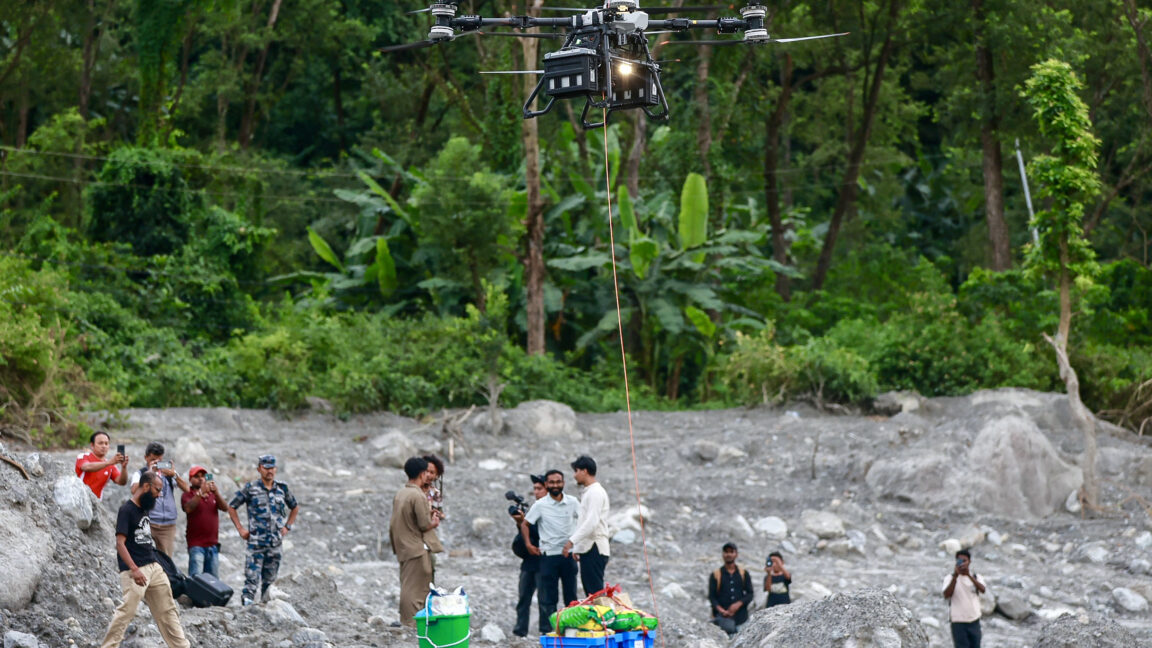
Chinese-made drones are airlifting the bodies of flood victims and delivering food to survivors in the aftermath of devastating flash floods on the border of Nepal and China’s Tibetan region. Nepal’s army has been using four DJI FlyCart 100 drones donated from China to make 10 to 16 aid deliveries each day, according to . This comes after a partial glacier collapse in the Himalayan mountains unleashed a sudden surge of water, mud, and debris that swept through border crossings, valley communities, and hydropower projects on August 26.
The DJI Flycart 100 Drones come with a 30-meter rope and winch system for picking up and dropping off heavy loads. The website of Chinese drone company DJI describes the drones as being able to carry between 187 and 220 pounds, depending on the battery configuration. The four Chinese cargo drones being used by the Nepal army are currently hauling about 132 pounds of supplies per trip, reported.
That heavy-lift capability has also allowed the drones to remove human bodies from some flood-stricken areas. The official death toll in Nepal had risen to 1,369 as of September 9, according to a situation report from the National Disaster Risk Reduction and Management Authority. The Nepal government agency also reported that more than 5,000 people are still missing, including 587 foreign nationals.
The same situation report also mentioned how the drones have helped to distribute 1,591 kilograms of food items across 31 flights. The United Nations is appealing for $20.5 million to help 43,000 people in the aftermath of the flood disaster in Nepal. Smaller drones have also proven useful in search-and-rescue efforts as Nepal has deployed more than 21,000 police and soldiers to look for survivors.
Search teams have occasionally found surviving workers trapped in hydropower tunnels after the floodwaters ripped through both operational hydropower plants and sites under construction. One drone pilot and filmmaker, Manish Maharjan, told AP News about flying small drones inside hydropower plant tunnels to help search for trapped workers but highlighted the challenges of flying drones through tunnels with many “bends, turns, or zigzags.” Maharjan also described finding some tunnels “filled with mud like toothpaste in a tube.” The drones carried microphone speakers that allowed rescuers to call out to potential survivors or play music, which helped locate survivors in a few cases, Maharjan said. The Nepal government’s September 9 update described 13,646 people as having been rescued so far.
Extract — continue reading at the source.