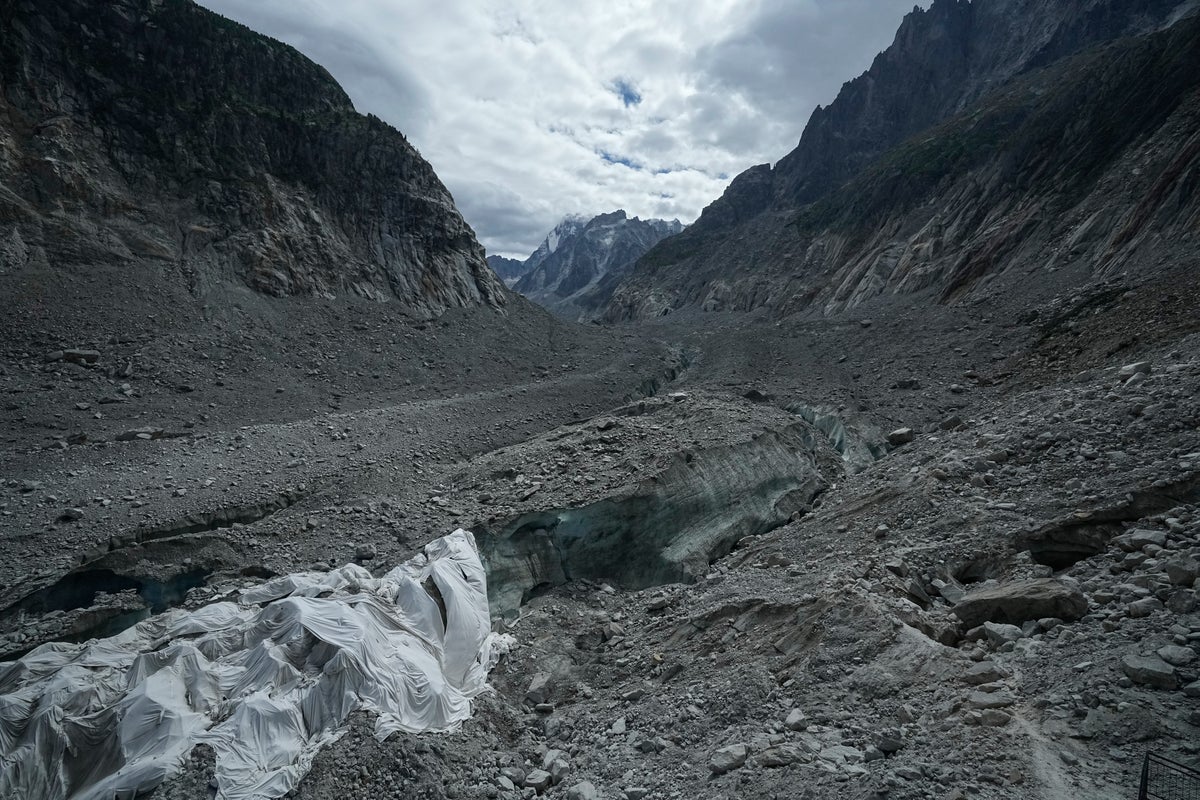
For centuries, French and Italian mountain communities on the flanks of Western Europe's highest peak have gazed upon seemingly eternal glaciers and snow that gave the colossus its name: Mont Blanc, the white mountain. But climate warming is dismantling the picture at alarming speed. Europe's record heat waves this summer savaged permafrost that for millennia has acted like glue on the Alpine landscape.
Defrosting cliffs came apart as high-altitude cold gave way to higher temperatures, sending rock falls cascading from the heights. A famously dangerous rock-prone gully that climbers have long braved on ascents to the summit, 4,805 meters (15,766 feet) up, became temporarily impassable. It hits us in the gut,” said Stéphane Bozon, a deputy mayor in Chamonix-Mont-Blanc, a French town at the foot of the giant that straddles France's border with Italy.
We saw areas becoming difficult to access because of glacial retreat and snowmelt on the glaciers, with crevasses opening up and rock collapses making some areas difficult to reach or traverse,” he told The . Each degree of warming can have an outsized impact. On the Aiguille du Midi peak, which rises to an altitude of 3,842 meters (12,605 feet) in the Mont Blanc range, average temperatures for July have soared.
From a chilly 1.6 C (33.8 F) in 1994, the monthly average for this July was the warmest ever recorded, at 3.3 C (37.4 F), says Meteo France, the national weather service. The Himalayan flood disaster hits close to home in the Alps In the wake of devastating floods in the Himalayas, AP talked to researchers, climbers and residents coping with the risks and uncertainties of climate change on Mont Blanc. The Aug. 26 floods that swept through Nepal and China were triggered after a collapse of bedrock and glacier ice sent debris and water surging through multiple Himalayan rivers.
Initial assessments of many scientists are that climate change played a key role in creating conditions for the catastrophe. As Earth’s global average temperature rises because of the burning of oil, gas and coal, the chances of such disasters increase. In the Alps, glaciers once admired for their icy majesty are being eyed with trepidation as they shrink and lose stability.
Bozon, who is in charge of safety for Chamonix, says his town urgently needs to prepare for “serious scenarios” of chunks of glacier or mountain potentially falling onto inhabited areas. In Italy, researchers are also documenting dramatic damage wrought by heat on glaciers this year. In Lombardy, Alpine glaciers have lost more than 40% of their surface area since 1991, according to the region's glacier service.
Extract — continue reading at the source.