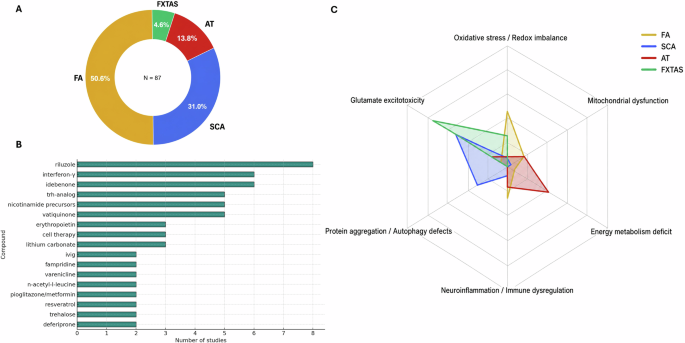
Hereditary ataxias are rare disorders, and a context where small cohorts and high development costs make drug repurposing a pragmatic route. Technological advances are creating opportunities to complement pathway-guided plausibility with more target-supported and AI-nominated mechanistically grounded candidates. Also, digital twin and The Virtual Brain frameworks should be viewed in hereditary ataxias as future-oriented research tools to integrate multimodal data, support stratification, and generate testable system-level predictions in rare cohorts.
Hereditary ataxia (HA) refers to a diverse group of rare neurodegenerative disorders characterized by progressive cerebellar dysfunction, manifesting clinically with gait instability, dysarthria, and impaired limb coordination. Despite shared cerebellar pathway involvement, these disorders show substantial genetic and phenotypic heterogeneity. Advances in next-generation sequencing and other molecular diagnostic technologies have revealed more than 200 disease-causing genes, encompassing a broad range of inheritance patterns, including autosomal dominant, autosomal recessive, X-linked, and mitochondrial transmission1,2.
The estimated prevalence of HA ranges from 3 to 6 cases per 100,000 individuals, although this varies considerably between populations and geographic regions3. Autosomal dominant spinocerebellar ataxia (SCA) is the most frequent subgroup, with a prevalence of approximately 5.6 per 100,000, while autosomal recessive forms such as Friedreich’s ataxia (FA) and ataxia–telangiectasia (AT) are less common4. The molecular mechanisms underlying these disorders are highly diverse.
They include trinucleotide or pentanucleotide repeat expansions, point mutations, copy-number variations, and structural rearrangements affecting genes involved in mitochondrial metabolism, oxidative stress regulation, DNA repair, ion channel function, and autophagy5,6. The clinical and genetic heterogeneity, combined with the low prevalence of each specific form, has major implications for therapeutic development. Traditional de novo drug discovery programs are constrained by high costs, protracted timelines, and the impracticality of conducting adequately powered clinical trials in small patient populations.
These factors limit the commercial incentive to develop entirely new compounds for these rare and heterogeneous conditions2. In this context, drug repurposing has emerged as a rational and pragmatic strategy to accelerate therapeutic development in rare neurodegenerative diseases. This approach seeks to identify novel clinical applications for compounds already approved or tested for other indications, leveraging existing safety and pharmacokinetic data to reduce clinical translation time and costs7.
Repurposing strategies are particularly suited to HA, where convergent pathophysiological mechanisms—such as oxidative stress, mitochondrial dysfunction, and neuroinflammation—are shared across genetically distinct forms. By focusing on these common molecular pathways, repurposed drugs may offer cross-etiological therapeutic benefits even in the absence of a gene-specific approach. Recent advances in computational methods, including artificial intelligence (AI), have markedly improved the precision and scalability of drug repurposing8.
Extract — continue reading at the source.


