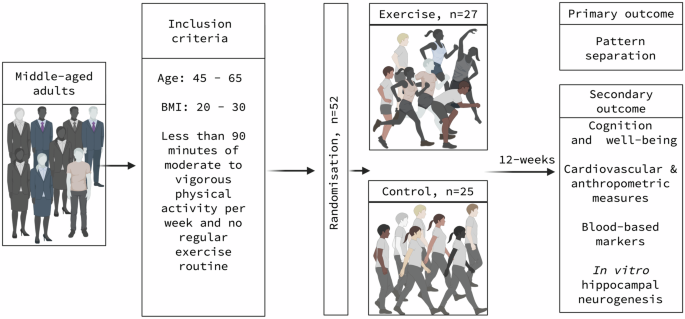
Middle age represents a critical window for mental and cognitive change, yet it remains relatively understudied as a target period for preventative lifestyle interventions. We conducted a three-month randomised controlled trial in healthy middle-aged adults in the UK (n = 52) to examine the effects of exercise on pattern separation, cognition and well-being, blood-based biomarkers, and hippocampal neurogenesis, using an in vitro parabiosis assay. No significant intervention-by-time effect was observed for the primary outcome, pattern separation (β = 0.33, p = 0.26).
However, significant intervention-by-time effects were detected for depressive symptoms, as measured by the PHQ-9 (β = −1.18, adjusted p = 0.011), and for the percentage of proliferative cells in vitro (β = −0.23, adjusted p = 0.02), suggesting that exercise remodels the circulating milieu in ways that directly influence hippocampal progenitor biology. Overall, our findings suggest that a structured, instructor-led, live online exercise programme in midlife is feasible and may produce temporally staged adaptations, with early effects on mood, intermediate systemic biological changes influencing hippocampal progenitor dynamics, and cognitive benefits that may require longer exposure to emerge. The trial was prospectively registered at Clinicaltrials.gov (NCT05397990).
Middle age, typically defined as the period between 40 and 65 years, is increasingly recognised as a vulnerable phase for mental health and emotional well-being. Large population-based studies demonstrate that subjective well-being and mood often decline during midlife, with a higher prevalence of depressive symptoms and psychological distress compared with earlier and later adulthood1. Notably, these changes coincide with major social and occupational transitions that can lead to reduced levels of physical activity2, which may in turn adversely affect quality of life and overall health.
Midlife also marks a critical window for both structural and functional brain changes3,4,5. Yet, despite its significance, this life stage remains understudied, both as a potential predictor of cognitive decline and as a target period for preventive lifestyle interventions. Among brain regions, the hippocampus has long been recognised for its central role in cognition, particularly in spatial and episodic memory6.
It is also sensitive to the ageing process, exhibiting non-linear changes across the lifespan, with pronounced alterations often beginning or becoming more apparent during the fifth and sixth decades of life7,8. As a result, the hippocampus has become a focal point of studies aimed at understanding and potentially mitigating age-related cognitive decline9. In humans, cost-effective lifestyle interventions, particularly physical exercise, have demonstrated the potential to attenuate age-associated hippocampal atrophy and increase hippocampal volume in healthy individuals and those with neurodegenerative diseases10,11.
In addition to its structural effects, exercise has been associated with enhancements in hippocampal-dependent cognition, including spatial memory10, and pattern separation12, a process by which the brain discriminates between similar, overlapping stimuli and new information. Pattern separation is understood to be dependent on adult hippocampal neurogenesis (AHN)13, a process through which new functional neurons arise from the neural stem cells located within the dentate gyrus of the hippocampus14,15,16,17,18. Interestingly, in vivo studies have demonstrated that AHN is sensitive to exercise19, supporting the hypothesis that exercise-induced modulation of hippocampal cognition occurs through regulation of AHN.
Extract — continue reading at the source.


