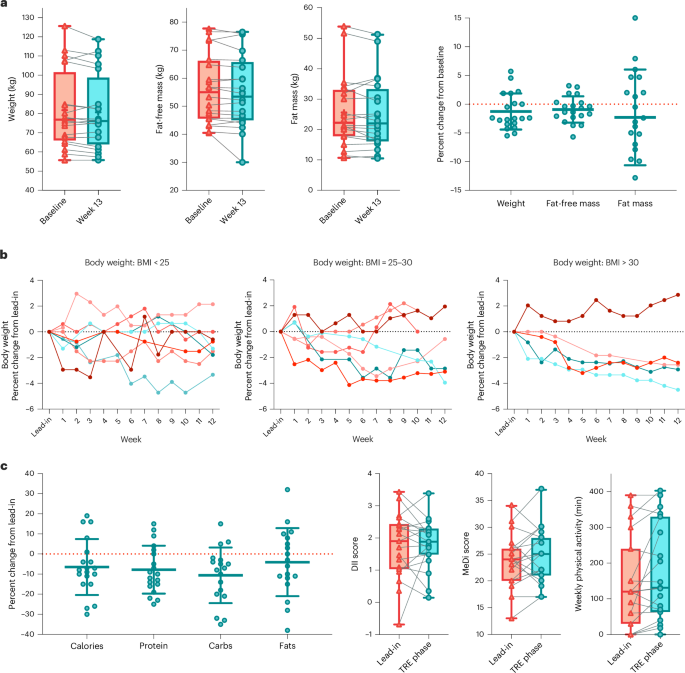
Time-restricted eating (TRE) has shown neuroprotective potential in preclinical models of Huntington’s disease (HD) but has not been tested clinically. Here, we report the results of a 12-week open-label pilot trial (NCT06490367) of 8-h TRE, alongside standard-of-care diet and activity recommendations, in 20 individuals with early-stage HD. We show that TRE is feasible, well tolerated and associated with favourable changes in clinical measures of HD and plasma neurofilament light levels.
Overall, these results support the need for further investigation of TRE as a potential lifestyle intervention in HD. This is a preview of subscription content, access via your institution Access Nature and 54 other Nature Portfolio journals Get Nature+, our best-value online-access subscription Receive 12 digital issues and online access to articles Prices may be subject to local taxes which are calculated during checkout Source data are provided with this paper. All other data that can be shared are available within the paper and in a published Mendeley Data repository at https://doi.org/10.17632/56pmntbndp.1 (ref. 54).
Neurol. 57, 369–384 https://doi.org/10.1097/00005072-199805000-00001 (1998). K., Filkuková, P., Frich, J. Age at death and causes of death in patients with Huntington disease in Norway in 1986–2015.
Huntingtons Dis. 7, 77–86 https://doi.org/10.3233/jhd-170270 (2018). Article PubMed PubMed Central Google Scholar Huntington, G. Neurosci. 15, 109–112 https://doi.org/10.1176/jnp.15.1.109 (2003).
Venezuelan kindreds reveal that genetic and environmental factors modulate Huntington’s disease age of onset. USA 101, 3498–3503 https://doi.org/10.1073/pnas.0308679101 (2004). Article CAS PubMed PubMed Central Google Scholar Trembath, M.
A retrospective study of the impact of lifestyle on age at onset of Huntington disease. Disord. 25, 1444–1450 https://doi.org/10.1002/mds.23108 (2010). Genetic Modifiers of Huntington’s Disease (GeM-HD) Consortium.
Extract — continue reading at the source.


