Great white sharks could remain near California beaches later than usual and move further north as El Niño brings warmer ocean conditions to the West Coast, researchers and state wildlife officials say, after already observing increased juvenile white shark activity in parts of Southern California during 2026. Elizabeth Hellmers, a senior environmental scientist at the California Department of Fish and Wildlife (CDFW), specifically confirmed to Newsweek that “there has been an increased number of sightings being shared on social media in 2026, as well as drone footage showing high abundance off Southern California beaches.” El Niño is the warm phase of the El Niño-Southern Oscillation (ENSO), a naturally occurring climate pattern in the tropical Pacific. It develops when surface waters across parts of the tropical Pacific become warmer than average and the trade winds, which usually push warm surface water towards the west, weaken.
The change affects ocean and atmospheric circulation, altering temperature, rainfall, and weather patterns around the world. In the southern United States, El Niño is commonly associated with wetter conditions over the winter, from fall through to spring. The warmer ocean conditions associated with El Niño can extend northward toward California, raising coastal water temperatures and potentially expanding the areas where juvenile white sharks prefer to live.
The current event is arriving after a separate marine heatwave had already raised temperatures off parts of the California coast. Juvenile great white sharks generally favor warmer nearshore waters more than adult sharks. Warmer waters can, therefore, expand their residence northward and allow them to stay in California for longer, instead of moving south toward Mexico as they would typically do.
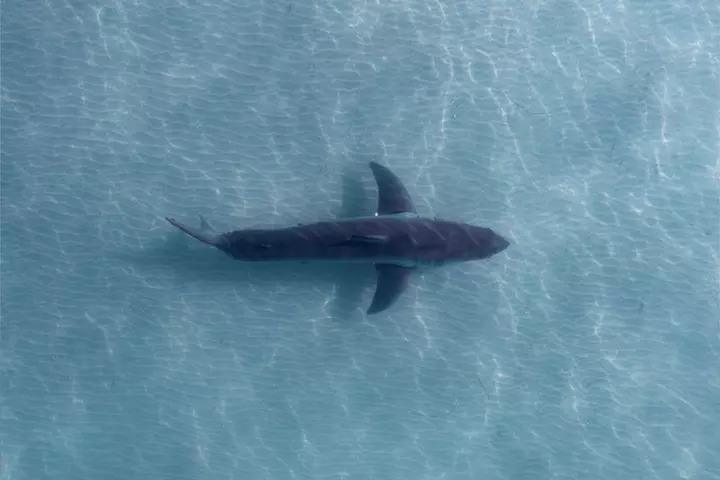
Hellmers told Newsweek that juvenile white sharks are commonly found close to the shore in Southern California from around April through to October. Beaches from San Diego to Santa Barbara serve as nursery grounds for young white sharks, and reports of increased numbers have emerged across that region. Neil Nathan, a senior research scientist at the Benioff Ocean Science Laboratory, said its SharkEye drone-monitoring program had “observed an increase in the abundance of white sharks” in its Carpinteria survey area, which is a section of nearshore waters around Carpinteria, in Santa Barbara County, this year.
Nathan said warmer waters during previous El Niño events have been associated with juvenile white sharks moving further north, appearing as far north as Monterey Bay, where “juvenile sightings have historically been rare.” His team has recorded more sharks in 2026 than during the past few years, although he’s still analyzing eight years' worth of data to determine how much of the change can be attributed specifically to the change in sea temperatures. Chris Lowe, a professor in the Department of Biological Sciences and director of the Shark Lab at California State University, Long Beach, told Newsweek that shark activity had recently changed in ways researchers didn’t anticipate. According to Lowe, a group of 20 tagged white sharks that had been gathering in one area all suddenly left within four days following a recent storm.
Some traveled north and others south, despite local water temperatures remaining within the preferred range for juvenile white sharks. Lowe said newborn white sharks appeared as early as February this year, compared with a more typical start around April. The number of sharks increased at several locations where they typically gather through the summer and peaked in September, before the largest group unexpectedly dispersed.
Extract — continue reading at the source.