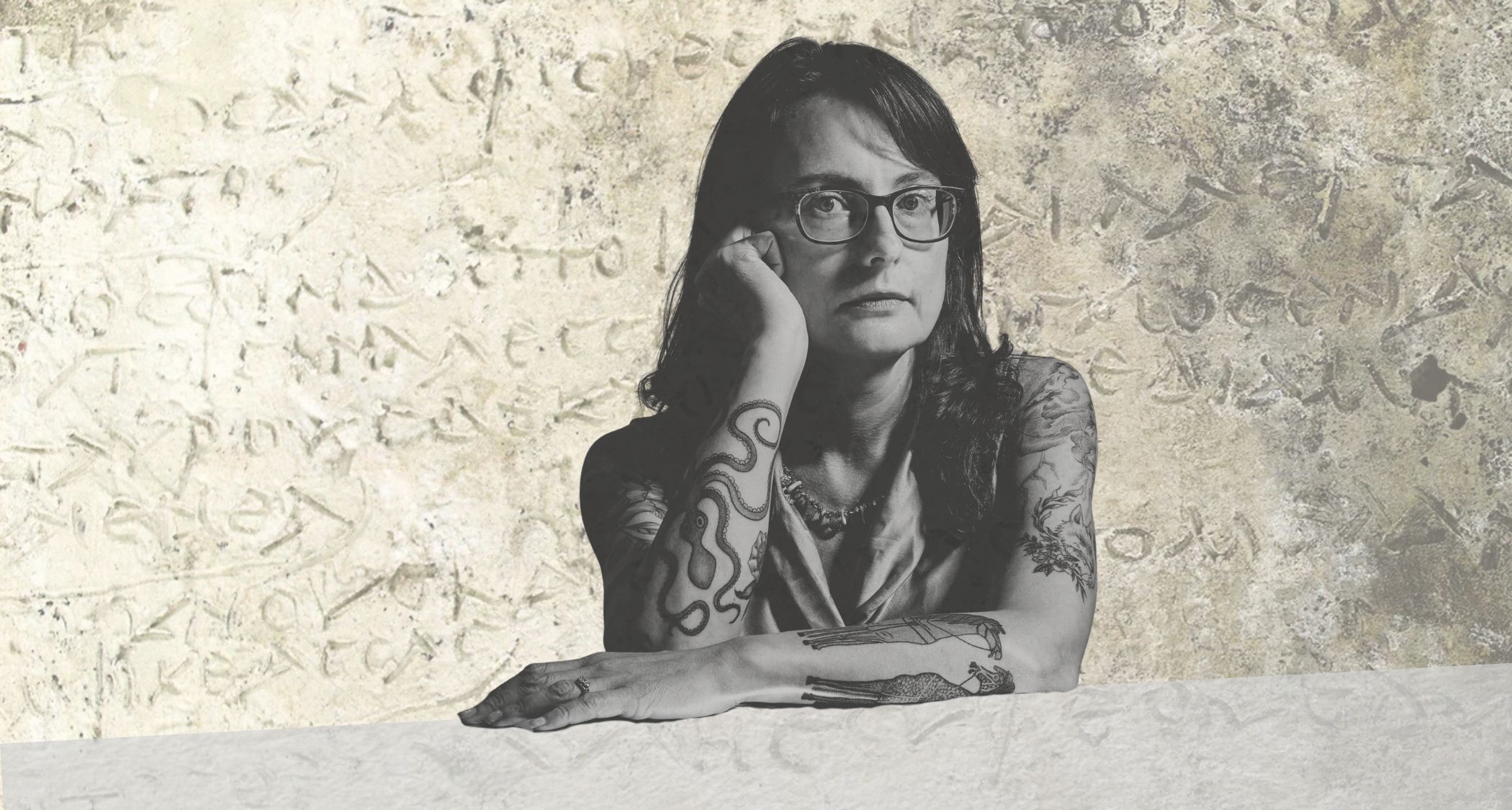
One of the most celebrated classicists writing today, Emily Wilson achieved a rare kind of literary stardom in 2017, when her translation of Homer’s Odyssey made her the first woman to publish a complete English version of the epic. Her work, which spans Sophocles, Euripides, and Seneca as well as Homer, is known for its rigorous commitment to traditional meter and its startling clarity. Increasingly a public figure as well as a scholar, Wilson found herself at the center of the cultural conversation again this year when Christopher Nolan cited her famous opening line as an important influence on his own conception of Odysseus, only for Wilson later to publish a sharply critical review of the finished film.
Like a lot of people, I was greatly looking forward to reading her new essay collection, Crossing the Wine-Dark Sea: Journeys Through Ancient Literature, which will be out in the US this September from Liveright. As a translator myself, I was especially eager to talk with her about the choices that make translation such an endlessly provisional art: what to preserve, what must inevitably be lost, and how to make an ancient world intelligible without losing the strangeness of it. Leanne Ogasawara: “Tell me about a complicated man” may be the most debated single line of translation in recent memory—one reader even joked that it sounded more like a relationship status on Facebook.
In your book you explain that polytropos can convey versatility, cunning, wandering, and the experience of being turned about by circumstance. How did you finally land on “complicated” and did the intensity of the reactions surprise you? Emily Wilson: I write about that choice at some length in Crossing the Wine-Dark Sea, so I will try not to replicate all that here.
I’ll just say for now that I arrived at that choice after many days of consideration and experimentation, and now, almost ten years later, I still don’t think I can improve on it, given the particular goals of my translation of the original poem. I aimed to echo the traditional, metrical poetics of the original, and its status as a text designed for oral performance—unlike most modern translators in English, who have used prose or free verse. So I needed a word that could scan, when followed by the stressed syllable of “man.” It’s good that so many people feel empowered to engage with a discussion about the high stakes and complexities of translation, no matter what their background, their knowledge, or their feelings may be.
I also aimed, unlike most translators, to recreate the rapid pacing of the original, so I didn’t want to translate one four-syllable word by a long multi-word phrase; doing so has certain obvious advantages in terms of echoing the ambivalence of this single word, but also obvious disadvantages in terms of slowing down the whole narrative right at the start. Like every translation choice, “complicated” is a compromise. It isn’t identical in denotation, connotation, register or sound to the original—and nor are any of the other ways translators have dealt with polytropos.
I think of it as being like democracy: the worst option, except for all the others.It’s not surprising that there was and remains so much fixation on the fifth word of the first line, in a poem that is over twelve thousand lines long. Sticking to one word in the first line saves a great deal of time. It’s good that so many people feel empowered to engage with a discussion about the high stakes and complexities of translation, no matter what their background, their knowledge, or their feelings may be.
Extract — continue reading at the source.