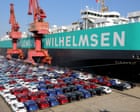
EU trade negotiators are heading to China for two days of crunch talks aimed at sealing a breakthrough deal tackling Beijing’s record £1bn-a-day trade surplus by curbing its exports of cheap hybrid electric cars into Europe. Trade commissioner Maroš Šefčovič and his team fly out on Wednesday and will be negotiating up to the wire in talks scheduled to start the following day and continue late into Friday. Sources say they hope to achieve “tangible, meaningful and measurable” results before the meeting of EU leaders in Brussels on Thursday next week, where China is high on the agenda.
The main focus is on what has been described as a “proof of concept” pilot agreement involving one sector, which is expected to be cars, which could be scaled up for other sectors in the coming months. Diplomatic efforts to avert a full-scale trade war started at the end of June, albeit with little hope that China could curb exports to the EU given its historic ability to pivot quickly any time trade barriers are put in its path. For example, after the EU imposed tariffs on Chinese electric vehicles in October 2024 there was a boom in exports of hybrid cars, which were not subject to tariffs.
Last month, the EU asked China to voluntarily restrict hybrid exports to address soaring sales, warning that if they did not restrict them, safeguards – which could include quotas – could be enacted. It is not known what China’s response was. But sources say the mood in talks has changed as EU member states have hardened demands for protection against Chinese imports that threaten their own industries.
On Monday, Germany’s chancellor, Friedrich Merz, agreed a “historic U-turn” on its policy on China by siding with the French president, Emmanuel Macron, in authorising effective permission for EU leaders to approve a new instrument to allow them to defend trade by cutting access to the single market at short notice. In a joint paper with Emmanuel Macron, the two countries spoke of “a massive industrial shock … affecting sectors at the heart of the European industrial model and of systemic relevance [pharmaceuticals, aerospace, automotive, machine tools, chemicals, etc.]”. The paper called for the use of all existing trade defence tools, but also for a new diversification instrument and “possible additional” new measures to allow the bloc to react when “third countries seek to undermine the restoration of a level playing field”.
Andrew Small, a former EU adviser on China, said Šefčovič’s talks will test the resolve of both Beijing and Brussels and will “determine whether China is willing to put sufficiently serious offers on the table”. Small, who is the Asia director at the European Council on Foreign Relations in Berlin, warned: “China’s most effective tactic may be to draw Europe into a ‘process trap’ offering just enough to delay action, without addressing the forces driving European deindustrialisation.” Sources say the Franco-German proposals for a new instrument, dubbed a “kill switch”, were born out of frustration, particularly in Paris, that a so-called “trade bazooka” available to Brussels, officially known as the anti-coercion instrument, has never been used. Paris pushed for the use of the ACI following Trump’s threat of tariffs last year but it never gained traction from others as it could take up to a year to implement.
Handlesblatt, the Germany business newspaper, described Monday’s change in policy as “nothing less than an economic turning point”, with chief political reporter Martin Greive concluding in a hard-hitting column that Merz was “putting an end to years of naiveté towards Beijing”.
Extract — continue reading at the source.