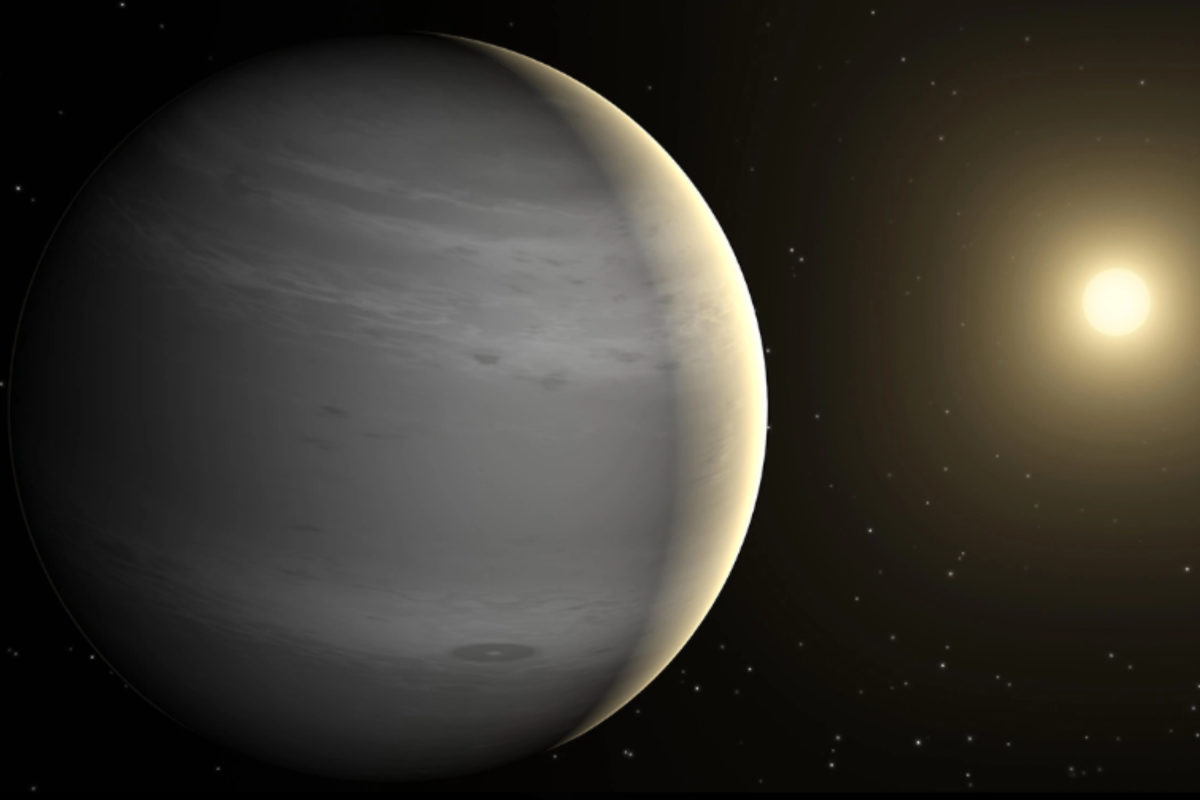
A group of astronomers has captured radio wave emissions from a planet beyond our solar system for the first time, which could help measure the magnetic fields of distant worlds. Researchers from the Center for Astrophysics, a collaboration between Harvard and the Smithsonian Institution, and the University of Oregon last week shared a preprint research paper on arXiv that reported the “first direct detection of auroral radio emission from an exoplanet, the giant planet Beta Pictoris b” - located roughly 64 light-years from Earth. Auroras, such as the northern and southern lights on Earth, are displays produced when charged particles interact with a planet’s magnetic field and atmosphere.
The astronomers used the MeerKAT telescope array in South Africa, 64 linked radio dishes that work together as one telescope, to study the planet’s star system four times in 2025 and 2026. They say they have now traced such a signal to Beta Pictoris b. Previous radio searches either found no signal from an exoplanet (planets beyond our Solar System) or detected a signal but struggled to determine whether it was from a planet or the star it orbited.
But in this case, the team says it was able to determine which signals came from Beta Pictoris b. While the signal itself does not suggest anything about whether Beta Pictoris b is habitable, the discovery matters because it could help astronomers do the same for other planets, and assess which ones could be suitable for life. This Beta Pictoris b discovery could indirectly be used to help in the search for alien life, because a magnetic field is sometimes used as a possible indicator of whether a world has conditions suitable for life - because magnetic fields help protect a planet’s atmosphere.
Magnetic fields can help prevent the “atmosphere from being lost to space” and “could also protect life on the surface from harmful radiation,” according to the National Aeronautics and Space Administration (NASA). NASA cites Mars as an example of a magnetic field performing this function. After the planet lost its global magnetic field, its atmosphere “became directly exposed to the solar wind and solar storms,” NASA says.
As the atmosphere eroded, “liquid water was no longer stable on the surface.” But magnetic fields can also “enhance total atmospheric loss” under certain conditions, Guillaume Gronoff and his co-authors wrote in a 2020 review published in the Journal of Geophysical Research: Space Physics. The presence of a magnetic field, even one that helps protect a planet’s atmosphere, does not by itself establish that a planet is habitable. Beta Pictoris b is a gas giant, a type of planet without a hard surface, making it an unlikely home for life as we know it, but if astronomers looking at rocky planets use the same methods as the researchers in this discovery to detect similar radio signals, the research could be used to determine whether the planet can keep an atmosphere and support liquid water.
Contact Newsweek editors on this story: Matthew Cannon and Cristina Diciu.
Extract — continue reading at the source.