After witnessing the horrors of World War I, the naturalist Henry Beston retreated to a tiny cabin on the dunes of Cape Cod in search of a peace that human civilization had shattered. There, watching the birds and creatures around him, he began to question humanity’s place in the natural world. In 1928, he wrote that animals “are not brethren, they are not underlings; they are other nations, caught with ourselves in the net of life and time.” Nearly a century later, science is revealing just how extraordinary those other nations really are.
For most of history we defined intelligence in our own image. Anything that didn’t fit got ignored. But now the evidence is piling up that the world is full of minds.
Birds with walnut-sized brains beat primates at logic puzzles. Forests trade information through fungal networks. Flocks of birds can possess knowledge no single bird does.
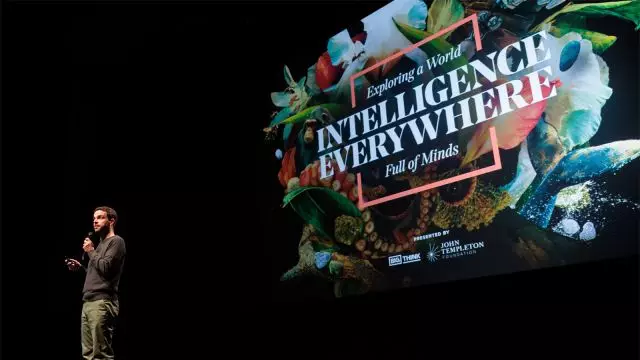
And now we’re even building a new kind of mind ourselves, one that writes poetry, passes medical exams, and sometimes seems to reason about its own existence. On October 3, 2026, at the Broad Stage in Santa Monica, Big Think and the John Templeton Foundation invited screenwriters, filmmakers, and storytellers to join us in defining intelligence. After all, if a slime mold can navigate a maze, an octopus can think with its arms, and a silicon chip can reason, what exactly _is_ intelligence?
And what do we owe to the minds we share a planet with? We called the event _Intelligence Everywhere: Exploring a World Full of Minds_, hosted by Chris Duffy, comedian, author, and host of TED’s _How to Be a Better Human_ podcast. **Diana Reiss**, professor of psychology at Hunter College, opened with a bet she has been making since the 1980s: If you give an animal more choice and control, it will show you more of its mind. Four issues delivered, plus every article, video, and event unlocked and ad-free.
Her first exhibit was an elephant. For years, Asian elephants had flunked insight tests in which they had to use sticks to reach rewards their trunks could not. Reiss and a student reran the experiment at the Smithsonian’s National Zoo, this time adding a movable cube in addition to the stick.
Extract — continue reading at the source.