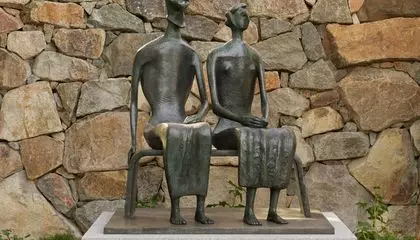
We descend underground into a cavernous space, seeing our own distorted reflections in stainless-steel panels on the walls. Designed by Hiroshi Sugimoto, even this entryway to the newly renovated Hirshhorn Sculpture Garden is a work of art. Sugimoto is really welcoming visitors of all sizes to play with their reflections here in this space.” As we continue the journey into the sunken garden, we find ourselves in a play of light and shadows and stone and bronze, among flowers, trees and the occasional insect.
A reflecting pool and a platform for stage performances sit in the middle of the grounds. The 1.3-acre plot underwent a multiyear transformation, following the 2022 groundbreaking of the revitalization project. It reopens to the public this Saturday, October 31.
The Hirshhorn opened in 1974 with the museum building’s famous “Brutalist doughnut” design, the creation of American architect Gordon Bunshaft. After half a century, the concrete ring is celebrated today. But the sculpture garden of 1974 was much different than the one of today, says Isgro: “At that time, it had one tree; it was sort of a very severe, unshaded space.” The garden was later redesigned by Lester Collins in 1981.
By the late 2010s, it needed another revamp. The Hirshhorn commissioned Sugimoto for the job in 2019. His relationship with the museum can be traced back to 2006, when he had a solo exhibition there as an artist.
Then, as an architect, he completed a redesign of the museum’s lobby in 2018. The new sculpture garden is a serene place, one for contemplation and meditation. Sugimoto also incorporated greater accessibility into the area, with ramps for wheelchair users.
The garden’s beacon welcoming visitors from the National Mall is a giant stainless-steel swimming pool sculpture weighing 55,000 pounds and standing 28 feet tall. The commissioned work by Berlin-based artist duo Elmgreen & Dragset is called Eight, named for its numeral 8 shape. It was “the largest crane that we’ve ever used at the Hirshhorn, that I know of,” he says.
Extract — continue reading at the source.