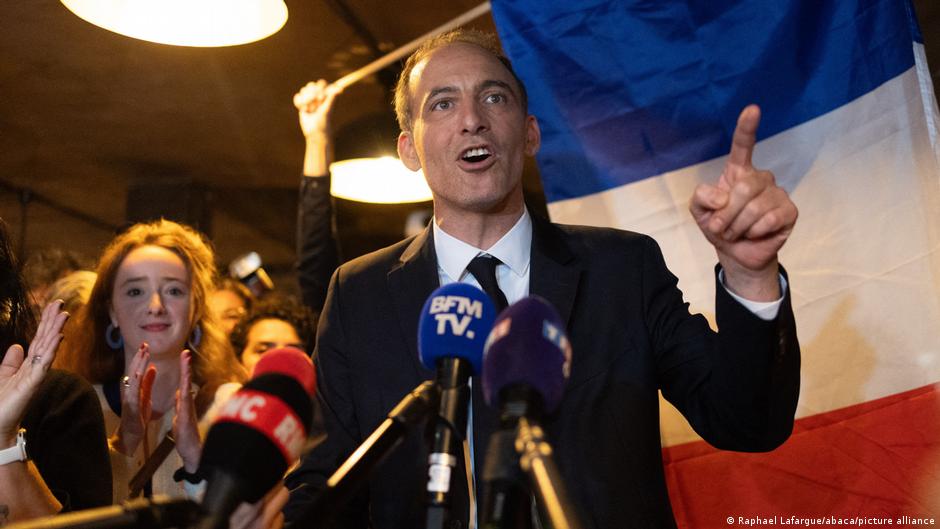
The historically working-class Parisian neighborhood of Belleville has gentrified in recent years. It was here that Raphael Glucksmann, a member of the European Parliament for France's center-left Socialists, celebrated his victory in the party's presidential primary on October 11. Two rounds of voting had been anticipated, but the 46-year-old son of philosopher and essayist Andre Glucksmann triumphed in the first round with a convincing 66% of the vote and will be the Socialist candidate in France's 2027 presidential election.
As he left the Cantine de Belleville restaurant, Glucksmann was flour-bombed by an unidentified assailant. The following morning, he called on his rival, the left-wing French populist Jean-Luc Melenchon, to condemn attacks carried out by his supporters, though it is not clear that the attacker was indeed a supporter of Melenchon's La France Insoumise (LFI). The incident has highlighted the issue set to dog Glucksmann's presidential candidacy over the coming weeks: How can he win over Melenchon's supporters if he refuses to work with their candidate?
"Where do you stand on Melenchon?" That was the question that dominated much of the Socialists' primary campaign. Party leader Olivier Faure spoke in favor of leaving the door open for cooperation with the LFI, but Glucksmann called for a clear break with the far left. His decisive victory is therefore also seen as a vote in favor of a clear demarcation.
The other primary candidates questioned Glucksmann's political experience. Segolene Royal, a previous presidential candidate, compared his bid for the Elysee with that of an "intern" wanting to take charge of a company. She said Glucksmann had no experience in government or even running a local authority.
Despite Glucksmann's victory in the primary, his starting position is a difficult one. A poll by Toluna Harris Interactive, published the day after his win, projects that he would win 10–11% of the vote. The same poll put Melenchon on 18%, meaning the far-left man would be much more likely to reach the runoff.
But the survey was conducted before Glucksmann won the primary, and so does not take into account any potential boost the nomination may give him. Still, 10% would be an improvement on the Socialists' performance in the last presidential election in 2022, when their candidate Anne Hidalgo won just 1.75% of the national vote. There is also the complication that the Socialists are banking on a man who is not even a party member to lead them from irrelevance.
Extract — continue reading at the source.