Aging is frequently accompanied by cognitive decline and neuroinflammation, both of which are closely linked to dysbiosis of the intestinal microbiota. Ganoderma lucidum polysaccharides (GLPs), as natural bioactive compounds, exhibit anti-inflammatory, immunomodulatory, and neuroprotective properties. Recent studies suggest that GLPs may influence brain function via the gut-brain axis; however, the precise mechanisms underlying this effect remain unclear.
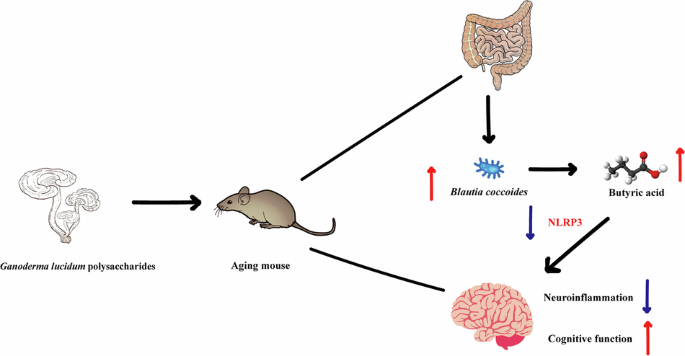
This study demonstrates that GLPs alleviate cognitive impairment in aging mice through a gut-microbiota-dependent pathway. GLPs treatment enriched the butyrate-producing bacterium Blautia coccoides, elevated fecal acetyl-CoA and butyrate levels. Direct supplementation with Blautia coccoides or butyrate similarly improved cognition and suppressed neuroinflammation.
GLPs notably ameliorated intestinal barrier damage and attenuated systemic inflammation. In the hippocampus, it inhibited microglial activation and NLRP3 inflammasome-mediated neuroinflammation. In NLRP3-knockout mice, these beneficial effects were not observed, thereby confirming that the pathway is NLRP3-dependent.
Fecal microbiota transplantation from GLPs-treated donors replicated cognitive and anti-inflammatory effects in recipients, establishing microbial causality. Furthermore, butyrate and Blautia coccoides-derived metabolites directly suppressed NLRP3 activation in microglial cells in vitro. Our work defines a novel Blautia coccoides-butyrate-NLRP3 axis through which GLPs mitigates brain aging, supporting its potential as a prebiotic therapy for age-related cognitive disorders.
We are profoundly grateful to Academician Feng Shao of the Chinese Academy of Sciences for his meticulous guidance and invaluable support for our project. We also extend our sincere thanks for his generous provision of the NLRP3 knockout mice essential for our experiments, as well as for his expert insights into the field of pathogenic bacteria and host interactions. The authors acknowledge the support received from the foundation.
This study was supported by the Key projects of Chongqing Key Laboratory of Development and Utilization of Genuine Medicinal Materials in Three Gorges Reservoir Area (KFKT2022001,to Jianhua Ran; KFKT2022010, to Boyue Huang); the National Natural Science Foundation of China grants (81770738, 82370739, to Jianhua Ran); 2025 Open Competition for Leading Talent Program on Digital- Intelligent Testing, Western Institute of Digital-Intelligent Medicine (WIDM2025JBGS-SZJY009, to Jianhua Ran); Chongqing Science and Technology Commission(CSTB2023NSCQ-MSX0510,to Jianhua Ran); Science Foundation of Chongqing Education Commission (KJQN202400417, to Boyue Huang); Chongqing Natural Science Foundation (Chongqing Science and Technology Development Foundation) (CSTB2024NSCQ-KJFZMSX0075, to Boyue Huang); the Key Project of Chongqing Key Laboratory of Development and Utilization of Genuine Medicinal Materials in Three Gorges Reservoir Area (Sys20210008 to Dilong Chen); Innovative Research Group Project of Natural Drug Antitumor of Chongqing Municipal Education Commission (CXQT20030 to Dilong Chen); Chongqing Talent Plan Project (cstc2022ycjh-bgzxm0226 to Dilong Chen); The Science and Technology Research Program of Chongqing Municipal Education Commission (KJZD-M202202701, to Dilong Chen); The Chongqing Municipal Special Project for Technological Innovation and Application Development (General Program) (No. CSTB2024TIAD-GPX0029, to Jing Li). These authors contributed equally: Shengyao Zhang, Han Wei, Qiongfang Wang.
Extract — continue reading at the source.