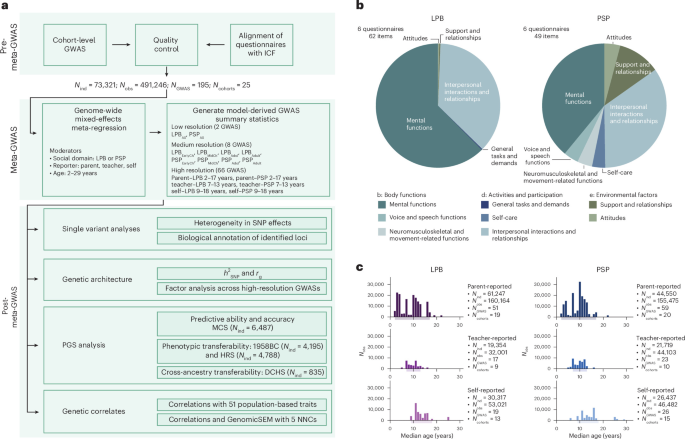
Social behaviour is a heritable trait linked to well-being and mental health, yet it varies across social context, including social domains, informants and development, which may shape its underlying genomic architecture. Here, we conducted a genome-wide meta-regression meta-analysis of social behaviour from infancy to early adulthood, studying ~500,000 repeated measures in European-ancestry cohorts (N = 73,321). We modelled heterogeneity in single-variant associations across social domains (low prosocial behaviour and peer/social difficulties), multiple informants (parents, teachers and self-reports) and ages (2–29 years), identifying 6 associated loci, including variation within CADM2 (P = 2.51 × 10⁻⁹).
Single nucleotide polymorphism-based heritability ranged from 2% to 7%, and the genetic architecture comprised 4 factors reflecting differences in either social domains or informants. Polygenic scores (N = 16,305) accurately predicted contextual variation in independent cohorts, with some cross-ancestry transferability. Context-specific patterns of genetic correlations, particularly when estimating the developmental onset of associations, offer opportunities to disentangle shared trajectories linking social behaviour with later-life and mental health outcomes.
Human social behaviour encompasses a broad spectrum of interindividual interactions that change across development and vary across social situations1,2. Prosocial behaviour involves voluntary actions that benefit others, such as helping, sharing and comforting. Early forms of prosocial behaviour can be observed from the age of 2 years3, and mastering increasingly complex levels of social competence during development shapes social roles in society2.
Social behaviour also includes peer and social difficulties, such as challenges to conform to developmental expectations, poor social skills, difficulties developing friendships and peer rejection4,5. In particular, childhood peer difficulties have been associated with lower academic performance, self-esteem, social engagement, problem-solving skills and resilience6,7. Thus, early social behaviour plays an important role in later-life friendships, well-being and (mental) health6,7,8.
Twin studies have shown that both prosocial behaviour and peer and social problems (PSP) during childhood and adolescence are heritable, with twin heritability (h2twin) estimates of 26–73% (refs. 9,10) and 24–71% (refs. 11,12,13), respectively. Corresponding single nucleotide polymorphism (SNP)-based heritability (h2SNP) estimates for PSP ranged from 2% to 27% (refs. 11,14). Yet, the genetic architecture underlying behaviour may vary by age and informant (for example, parent versus teacher reports)9,11,15,16.
Therefore, differences in genetic effects may also reflect variation in developmental processes driving social behaviour in different social situations. However, a systematic genomic investigation of the contextual factors contributing to heterogeneity in prosocial behaviour and PSP is still outstanding, in particular as large-scale genome-wide studies of social behaviour-related traits have exclusively been conducted in adult samples17,18,19,20. In turn, matching contextual factors between discovery and target phenotypes may systematically affect the accuracy of derived polygenic scores (PGS), necessitating the calibration of polygenic analyses to improve power21, and have not yet been studied for social behaviour.
Extract — continue reading at the source.


