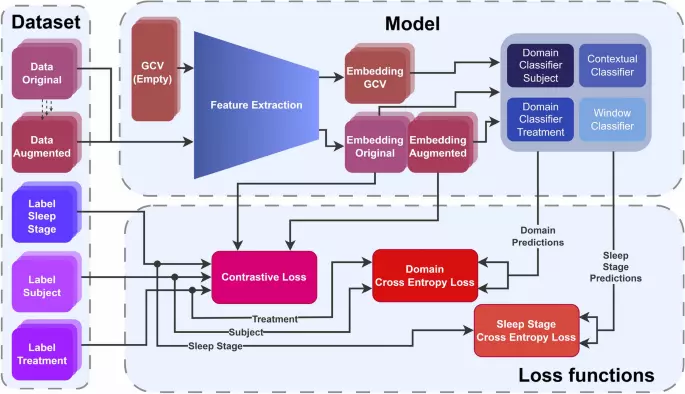
Sleep stage classification from electrophysiological signals is essential for studying brain function in preclinical neuroscience, yet models often fail to generalize across subjects and experimental conditions, particularly under pharmacological interventions that alter neural and muscular activity. We propose a robustness-oriented deep learning framework that integrates multi-branch feature extraction, global contextual representation, sequence modeling, and training strategies designed to reduce sensitivity to subject- and treatment-specific variability. The approach is evaluated on a large rodent dataset comprising over one million annotated EEG and EMG segments collected from multiple animals across several pharmacological conditions.
It achieves strong classification performance, substantially outperforming both classical methods and standard deep learning baselines. Notably, the model maintains stable performance across treatments, showing minimal degradation when trained on limited conditions, and remains effective even with relatively small amounts of annotated data. These findings demonstrate that accurate and robust sleep stage classification is achievable despite pronounced experimental variability.
The proposed framework reduces reliance on extensive annotation and improves the reliability of automated sleep analysis, supporting more scalable and reproducible preclinical research. Sleep stage classification is an important task in neuroscience and preclinical research because it provides a structured framework for linking neural activity to behavior, physiology, and disease mechanisms1. Accurate staging is essential for interpreting electrophysiological signals, quantifying sleep architecture, and comparing results across experiments and species.
In preclinical models, sleep staging enables the investigation of how pharmacological interventions alter brain function in a controlled setting, supporting mechanistic insights that are difficult to obtain in humans2. Deep learning approaches have substantially advanced automated sleep stage classification3. However, models may inadvertently learn subject-specific characteristics (individual baseline activity patterns, electrode impedances, or amplifier gain settings) rather than sleep stage patterns that generalize across these nuisance factors4.
This overfitting manifests as high in-distribution performance coupled with substantial degradation when models encounter data from previously unseen subjects or conditions5. Pharmacological interventions introduce particularly structured domain shifts. Psychoactive substances systematically alter neuronal excitability and neuromodulatory tone, producing predictable changes in EEG spectral content and EMG amplitude6,7.
For example, serotonergic compounds such as psilocybin suppress REM sleep and alter slow-wave activity, while 5-HT2A antagonists such as MDL100907 produce distinct changes in EEG power spectra that can shift the marginal feature distributions underlying a classifier’s decision boundaries. Models trained on control recordings may therefore fail on pharmacologically manipulated data, even when the underlying sleep stage identities are preserved. Prior deep learning methods for automated sleep staging (including convolutional architectures8, residual networks9, and attention-based models3) have demonstrated strong within-dataset performance but are predominantly evaluated using random train-test splits that preserve the training distribution.
Extract — continue reading at the source.