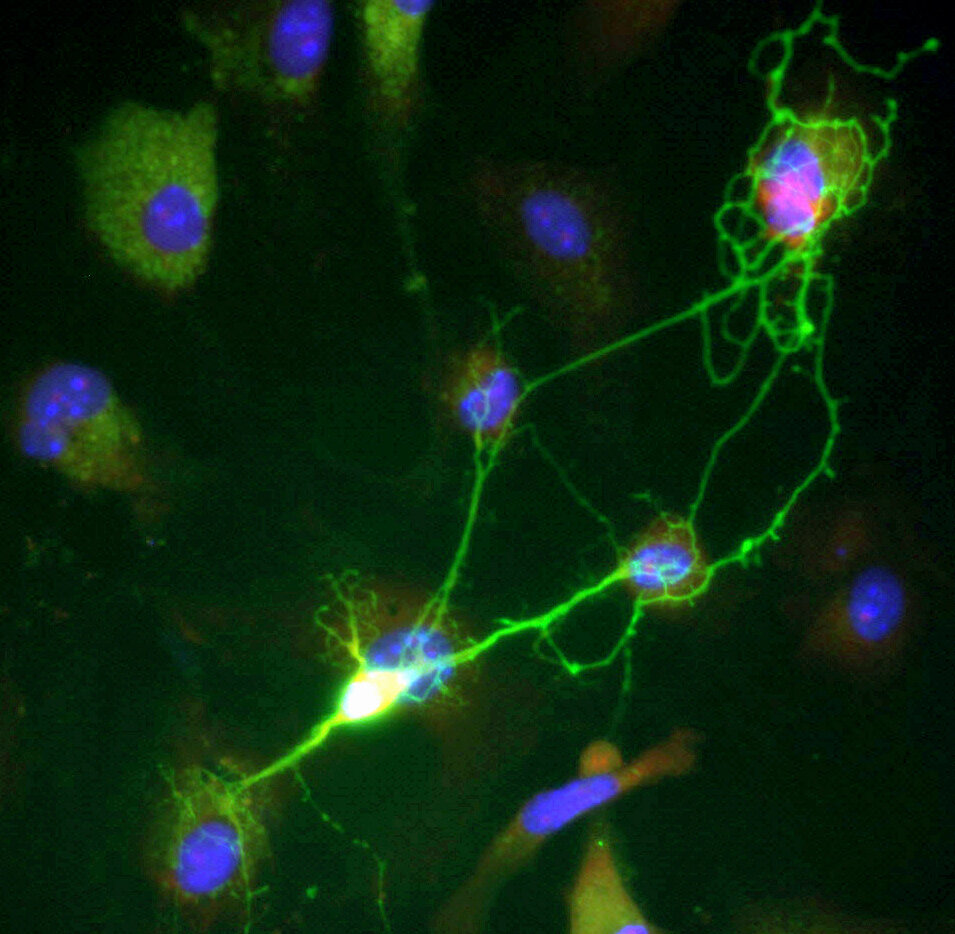
This article has been reviewed according to Science X's editorial process and policies. Editors have highlighted the following attributes while ensuring the content's credibility: A technology developed at The University of Queensland allowing scientists to observe how disease-related proteins behave inside living neurons will be used to advance early drug discovery for neurodegenerative diseases. The NASTIC (Nanoscale Spatiotemporal Indexing Clustering) platform, spun out into Brisbane-based startup Accretion Bio, enables researchers to study real-time biological processes in living cells across space and time at the single-molecule level for the first time.
The platform is the result of more than two decades of research at UQ's Queensland Brain Institute (QBI), led by professor Frederic Meunier. Meunier said NASTIC emerged from a fundamental scientific question about how proteins behave in living brain cells. The underlying science was published in Nature Protocols.
"NASTIC allows us to track how key proteins move, cluster and interact inside living neurons and observe how potential drug candidates influence those behaviors," Meunier said. "It provides an unprecedented view of what happens as diseases such as Alzheimer's and Parkinson's progress. "Progressing the platform from discovery to commercial application is an opportunity to help researchers and drug developers make better-informed decisions, and ultimately, improve outcomes for patients affected by neurodegenerative diseases." With support from UQ's commercialization company UniQuest, NASTIC has been spun out into startup Accretion Bio, backed by global venture firm Antler.
Accretion Bio was founded by Phillip Craig with technology co-founders Meunier and his QBI colleague Dr. Craig, Accretion Bio CEO, said the company would work with pharmaceutical and biotechnology partners to apply NASTIC to their programs while advancing its own neurodegenerative disease drug discovery program. "The industry has been making high-stakes decisions about which targets to pursue and which drug candidates to advance without a crucial layer of mechanistic data about what's actually happening inside a living cell," Craig said.
"In neurodegeneration, that functional information gap is one reason programs fail late and expensively in the clinic. "NASTIC allows us to observe how a drug candidate changes its target's behavior in real time, in a living cell, early in discovery. "That is not an incremental improvement—it is a new class of evidence." While Accretion Bio's initial focus would be on neurodegeneration, the platform could also resolve receptor clustering which drives cell signaling in immunology and oncology.
NASTIC has drawn interest from global pharmaceutical companies, and industry-funded research using the platform is already underway at QBI. Antler Australia partner James McClure said Accretion Bio was playing a vital role in the drug discovery life cycle. "The startup has true domain expertise and an ideal CEO to bring this successfully to the global pharmaceutical stage," he said.
Extract — continue reading at the source.