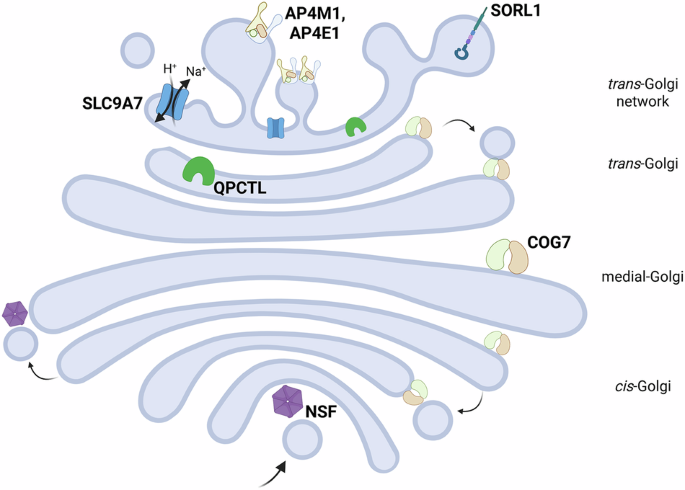
Deciphering the intricate pathogenesis of Alzheimer disease (AD) has been a highly demanding task for researchers for decades. Evidence from from human multiomic studies provides critical insights into complex disease mechanisms and drives novel findings. However, the data are often selectively comprehended, leaving a few notable factors underappreciated in the research field.
We focus on the Golgi apparatus, one of the most undervalued organelles in AD research, to demonstrate its multidimensional contribution to the pathogenesis. Given the importance of Golgi in modulating intracellular protein and lipid homeostasis, implication of Golgi in AD pathogenesis deserves thorough investigation. In this review, we describe changes in Golgi morphology and function in AD, and summarize specific Golgi-related factors discovered by genomic, transcriptomic, proteomic, and lipidomic data using human samples.
Based on the findings, we demonstrate mechanistic link of Golgi-related factors to AD pathogenesis and highlight potential therapeutic strategies to modify Golgi-mediated pathogenesis. Overall, Golgi dysfunction may serve as a notable mechanistic hub of AD pathogenesis, making it a promising target for development of novel therapeutic strategies. Alzheimer disease (AD) is a memory-affecting disease characterized by the accumulation of amyloid plaques and neurofibrillary tangles in the brain, which leads to the loss of neurons and ultimately cognitive decline1.
It is not only the most prevalent neurodegenerative disease but also one of the major causes of death in the elderly. According to the 2024 data, an estimated 10.9% of Americans aged 65 and older had AD, and it was the fifth leading cause of death in that population2. Given this clinical importance, numerous researchers worldwide have struggled for decades to elucidate the cause and pathophysiology of this disease.
Owing to such efforts, a great deal of findings has revealed important aspects of disease pathophysiology; however, critical knowledge gaps remain to be addressed. Anti-amyloid antibodies, lecanemab and donanemab, have been approved as new drugs for AD since 2023. These antibodies promote clearance of amyloid plaques and significantly delay cognitive decline3,4.
Proof of concept that removing toxic amyloid plaques can lead to improved clinical outcomes supports the old ‘amyloid cascade theory’5. However, the limited effectiveness of anti-amyloid antibodies emphasizes the demand for therapeutic strategies targeting other aspects of the disease. One of the most promising strategies is to resolve predisposing conditions that cause the production of toxic amyloid-β (Aβ) species, as this method would have a complementary and synergistic effect with the amyloid plaque-clearing antibodies.
Extract — continue reading at the source.


