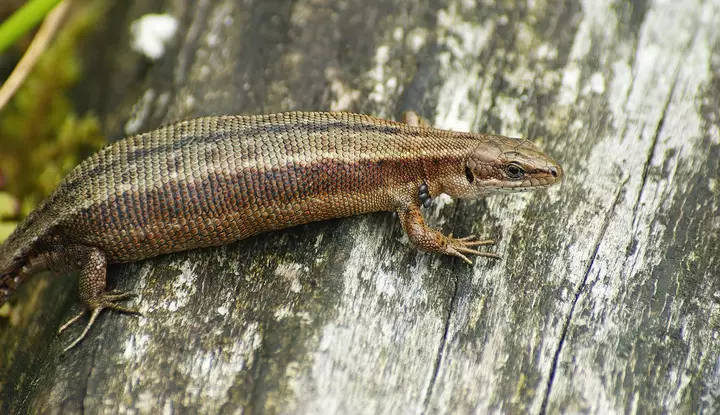
Great expectations: Certain populations of the European lizard (_Zootoca vivipara)_ get pregnant and bear live young. Goodbye, eggshell: How pregnancy emerged in the animal world Mammals evolved live birth just once; lizards and snakes did it over and over. What set the stage for this drastic change and how was it orchestrated?
Pregnancy was a singular innovation for mammals. Live birth emerged just once — likely during the Jurassic period. Critters that kept their offspring safely inside until full term became the predominant mammals.
Like the emergence of vision much further back, this was a monumental change that involved many alterations to biology. Evolutionary biologists would like to know what environments made pregnancy advantageous, how animals changed their reproduction to make it work, and what genes were updated in the process. But the one-off, long-ago emergence of mammalian birth makes that a difficult puzzle to crack.
Fortunately for curious scientists, pregnancy wasn’t such a rare development in other groups of animals. Egg-laying fish switched to live birth a couple dozen times; amphibians did it a handful of times. The champions are lizards and snakes, a group that scientists call squamates, which evolved pregnancy an estimated 121 distinct times.
Different groups of animals have evolved pregnancy multiple times. While mammals did it just once, the switch to live birth is estimated to have happened 121 times in lizards and snakes. The multiple instances when pregnancy emerged make it a prime example of convergent evolution, where the same feature (like flight, opposable thumbs or camera-like eyes) arises in different lineages.
Scientists can seek patterns in these numerous reproductive switcheroos: What steps, features or genetic changes do they share? The answers might offer clues to how pregnancy evolved in our own mammalian case. Though there’s some debate, most scientists believe that egg-laying is the ancestral form of reproduction among vertebrates.
Extract — continue reading at the source.