Inhabitants of the seafaring Bronze Age settlement of Akrotiri watched smoke plume from Thera, a long-dormant volcano on what is now the Greek island of Santorini. People gathered their belongings and safely stored the valuables they were forced to leave behind. Then they fled by boat to nearby islands.
When these minor earthquakes and eruptions subsided, residents returned to Akrotiri, collecting materials for reconstruction and beginning the arduous process of repairing the damage. But the ground continued to tremble. As conditions worsened, they made the difficult decision to flee once more, hopeful that their homes would survive the coming devastation.
When Thera erupted again, the explosion was so powerful that it destroyed Akrotiri, burying the settlement (and the island that shared the volcano’s name) in some 200 feet of ash and pumice stone. The timing of the disaster is the subject of intense debate, but scholars generally date it to between 1620 and 1530 B.C.E. The event was one of the largest volcanic eruptions in recorded history: Thera released about four times more volcanic material than the infamous Krakatau eruption, which killed upwards of 36,000 people in what is now Indonesia in 1883.
The ash cloud formed by the Thera eruption completely transformed the island’s lush, humid environment into an arid one. Ash from the volcano was so widespread that it rained down as far as modern-day Egypt and Israel. Layers of sand and pebbles found between archaeological deposits suggest that multiple tsunamis also contributed to the destruction.
But the biggest fallout of this cataclysmic event happened when a portion of the volcanic caldera collapsed into the sea a few days after the eruption, forever changing the landscape of Santorini. This plummet into the depths of the Aegean Sea has become the stuff of legends. Some claim that Akrotiri is the lost city of Atlantis, which the Greek philosopher Plato described centuries later, around 360 B.C.E.
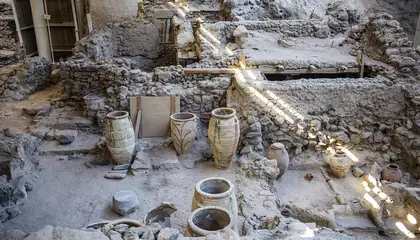
Most modern scholars, however, agree that Plato created the tale of the sunken island as an allegorical device. Much like the Roman city of Pompeii, which was destroyed when Mount Vesuvius erupted in 79 C.E., Akrotiri was preserved beneath the ash. This created a rare time capsule that provides an unprecedented look into the daily life of this Middle Bronze Age Cycladic civilization, so called after the Aegean islands where the culture flourished between about 3000 and 1000 B.C.E.
Extract — continue reading at the source.