Our ancestors may not have lived among traditional dinosaurs, but they did live among avian dinosaurs. Massive birds of prey with monstrous wingspans darkened the skies for the bulk of hominin evolution, and it’s possible they shaped our development, according to a new report by the BBC. Before Lucy, one of the earliest hominin relatives discovered was unearthed from a Limestone quarry in Taung, South Africa, in 1924 alongside a cache of animal bones.
The 2.8-million-year-old skull, belonging to a toddler, was termed the Taung child and a member of the newly named species Australopithecus africanus. Seventy years later, paleontologists analyzing the bones found alongside the Taung skull suggested they bore an eerie resemblance to the kind of skeletal assemblage you might find in the nest of a large bird of prey. Read more: “New Feathered Dinosaur is the First Megaraptor Discovered in Europe” Following up on that study in 2006, Scott McGraw and a team of fellow anthropologists compared markings on the Taung child’s skull to those on the skulls of monkeys that were snatched up by the African crowned eagle.
According to their analysis, the markings matched. Distinctive talon scratches along the eye sockets of both primates told a gruesome story of the Taung child’s death. This constant fear of death from above may have altered the course of human evolution, per McGraw and archaeologist James Cole of Brighton University.
The threat of birds of prey cannonballing out of the skies to snatch a child may have fueled the need for sociality, forcing hominin ancestors to band together to warn one another. Among other primate species, the alarm calls for terrestrial threats like lions and leopards are the same, while eagles get their own distinctive sound. McGraw, Cole, and others say this kind of vocal signalling flexibility could represent the roots of language.
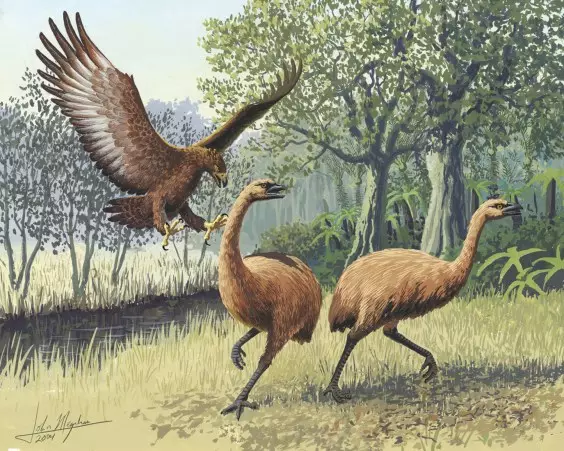
While any imprint these flying leviathans left on human evolution is largely speculative, the cultural impact they had is closer to undeniable. Teratorns, massive condor-like predators that soared above the Americas until as recently as 10,000 years ago, may have been the inspiration for the mythical Thunderbird of Native American folklore. Additionally, New Zealand’s Haast’s eagle, with an eight-foot wingspan, could have been the source of Maori legends of Te Hokioi, a child-grabbing raptor with talons like panther’s paws.
For better or worse, both species are now gone forever. The bird with the largest wingspan (12 feet, a far cry from teratorn species’ 20-feet) is an albatross, only feared by fish. It’s a loss to the natural world, but at least we don’t have to check the daily raptor report before sending our kids to school.
Extract — continue reading at the source.