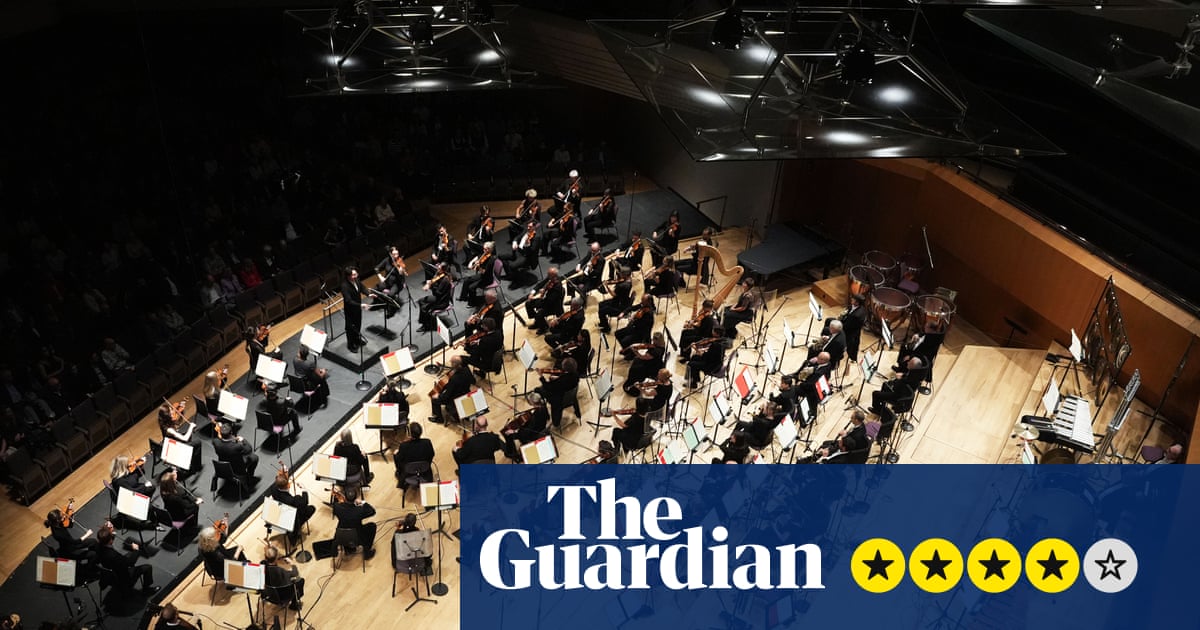
The acoustics of the Barbican, Royal Festival Hall and Royal Albert Hall; the practicality of Usher Hall and St George’s Bristol; those seats at Snape Maltings, and that foyer at Birmingham’s Symphony Hall. But do we really have it so bad? As Manchester’s Hallé opens its season with a celebration of 30 years of the Bridgewater Hall, it’s a good moment to remember what we’ve gained in the three decades since a car park became Britain’s best acoustic.
A flagship London hall may still be a fantasy, but with Gateshead’s Foster-designed Glasshouse, Saffron Hall, Kings Place and Milton Court all opening their doors since 2000, it’s hard to feel despondent. The Hallé and principal conductor Kahchun Wong celebrated their home’s birthday with a major new commission – James MacMillan’s sixth symphony. After a cycle of symphonies that seemed to work up to the choral epic of 2019’s fifth, the sixth feels like a new beginning.
There are echoes of both Elgar’s Enigma Variations and Britten’s The Young Person’s Guide in a work that looks simultaneously in and out: inward to the family members who inspired four short, expositionary movements – the key to the wild parade that follows – and outward to the composers who inspired the fifth movement’s subsequent textural and formal manipulations. The effect is disorienting. There’s a pastoral, folk-inspired trio of flutes, a buzzing swarm of muted brass, a peal of gongs, bells and bowed vibraphone, and a yearning solo cello.
And, standing apart from the rest, a Debussyean duet for harp and piano. How are we to assemble the fragments? Optimistically, MacMillan and an incisive Wong seem to urge.
Low woodwind and trombones (together with a nagging siren) may attempt to pull us under, but surging life-force in brass-gilded climaxes pushes valiantly back. Tempests rage, but the still, small voice of the alto flute gently persists. What a clever choice to frame the symphony with a rare performance of Liszt’s compact epic Les Préludes (brass resplendent in the narrative highs, strings fretting convulsively in the lows) and Beethoven’s Piano Concerto No 5: battles, both, for man’s survival and supremacy.
Perhaps egged on by this cumulative energy, we got a more robust “Emperor” from soloist Stephen Hough than usual, his opening cadenza flinging down a gauntlet gleefully plucked up by Wong and his players in a heroic duel that climaxed in an exuberant, close-combat finale.
Extract — continue reading at the source.