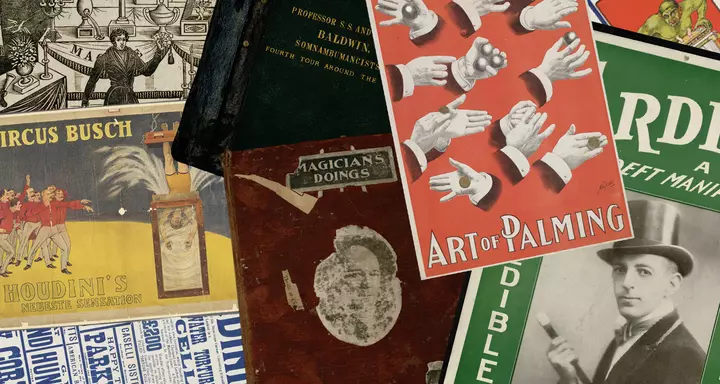
Magician and escape artist Harry Houdini was quite the collector, filling warehouses and his Harlem home with books, posters, newspaper clippings, and more. It probably shouldn’t be surprising that Houdini was a bit obsessive, but his collecting was next level. Some of his library was for the craft, and helped him build his act—he collected books on safes and prison architecture, as well as catalogs from lock manufacturers—but he also had an archivist’s eye.
Houdini had a particular obsession with documenting and preserving items related to the history of magic, spiritualism, and theater, and by the end of his life had amassed impressive collections that rivaled those at Harvard and the British Museum. Everywhere Houdini traveled he bought books, he had standing relationships with rare book dealers, and he took out ads in magazines asking for new materials and leads.The fixation was so extreme, according to the introduction to Eric Colleary’s new book Houdini’s Library, that in a moment of frightening airplane turbulence Houdini remembered, “Honestly I thought of my wife and theatrical collection.” In addition to his book, Dr. Colleary has put together an exhibition of materials also called “Houdini’s Library,” on display through January at the Harry Ransom Center at UT Austin.
Just in time for the 100th anniversary of Houdini’s death on Halloween, here are a few interesting books and items from the magician’s collection. The Houdini Library Catalog Houdini typed up a fifty-three-page document cataloging all of the current books in his collection, which included his thoughts on each volume. My favorite note is for a 1901 book called Entschleirter Magnetismus by Joseph Gregerowitsch: “This Doctor is the best that ever tried this game and he actually believes in it himself.
This hypnotism is a wonderful thing for those who believe in the power of the hips.” Harry Houdini, The Unmasking of Robert-Houdin Jean-Eugène Robert-Houdin was one of the first performers who inspired a young Erik Weisz to pick the stage name Harry Houdini, an homage to this early and important influence. But as Houdini spoke to Robert-Houdin’s contemporaries and collected more information, he began to realize that his idol was mostly exaggerating and plagiarizing from other performers. Houdini’s disillusionment became a book called The Unmasking of Robert-Houdin, which Houdini paid to have translated into French, Robert-Houdin’s mother tongue.
First edition of the 1584, Discoverie of Witchcraft by Reginald Scot One of the earliest books in English known to have skeptically challenged the persecution of supposed witches. Houdini had this copy shipped from England during World War I, and paid an extra fourteen shillings for “insurance & war risk.” The Sermons of Bernard de Clairvaux, with a forged letter claiming ownership by Martin Luther Hermann Kyrieleis had a short, infamous career in 1893-96 forging fake documents attributed to Protestant reformer Martin Luther, including the letter included with Houdini’s copy of sermons by a 11th century abbot, mystic, and co-founder of the Knights Templar. The book is real, but Luther’s letter is not—Kyrieleis was unmasked, arrested, declared insane, and tossed into an asylum.
It’s not clear whether Houdini believed the fake letter or knew this to be an example of a famous literary hoax. Ephemera about Count Cagliostro and the Affair of the Diamond Necklace An 18th century scandal around a necklace tarred the reputations of King Louis XVI, Marie Antoinette, and numerous royals, but a magician known as Cagliostro was also at the center of the affair. Houdini’s fascination with the scandal led him to scour Cagliostro’s house in Paris and purchase troves of papers from London and elsewhere.
Extract — continue reading at the source.