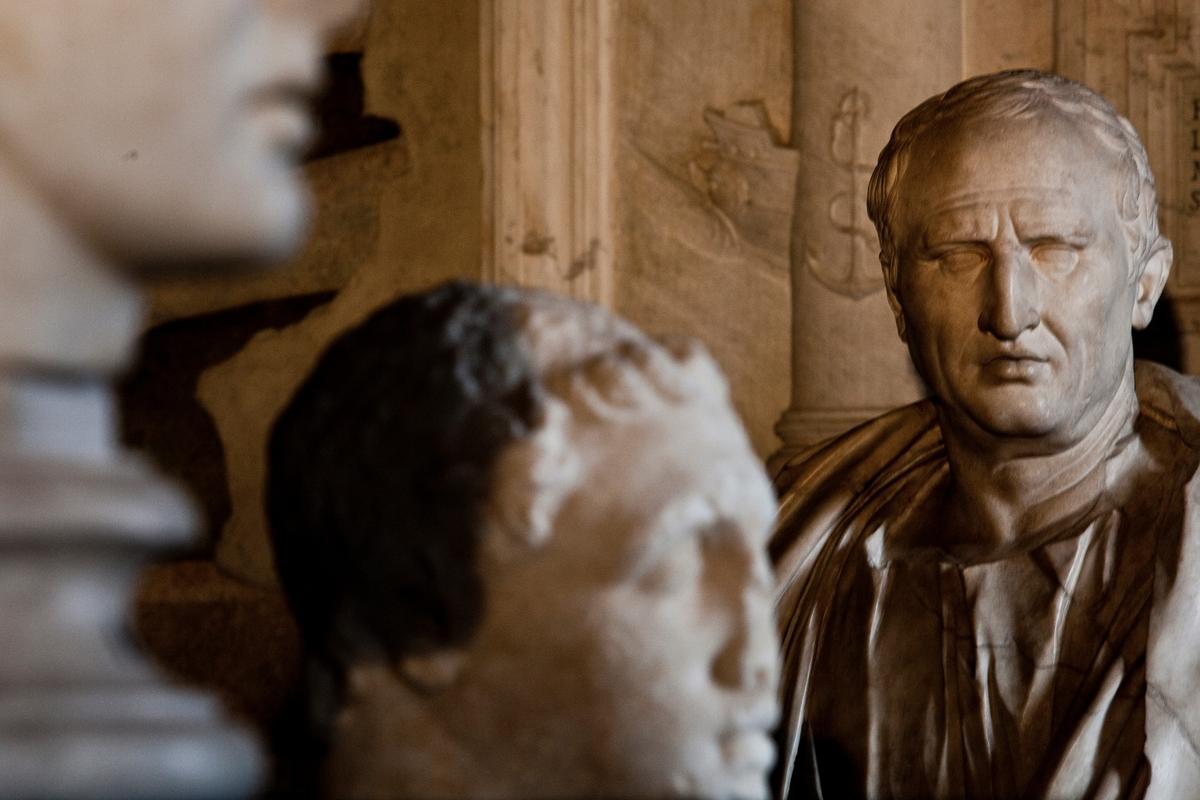
Photo by Alessandra Benedetti/Corbis via How tightly should you hold your beliefs? You face the question several times a week without noticing. Hold them too loosely and you don’t stand for anything, hold them too tightly and you become the sort of person no argument can reach.
Most of us swing between the two and have no vocabulary for the ground in between. A Roman lawyer worked one out, under pressure far worse than anything we are likely to face, and it is still the best answer available. The time is early 45 BCE, the place a villa near Lucrine Lake, northwest of Naples, in southern Italy.
One of the most fascinating and controversial figures in the entirety of Western history, Marcus Tullius Cicero, is finishing writing a book that will be known as the Academica, where he explains the nature of sceptical philosophy and why it is so crucial not just to the advancement of human knowledge, but to living a good life. It is a strange moment to retire into one’s villa to write. The Roman Republic, so beloved by Cicero, is about to be destroyed by aspiring autocrats: Julius Caesar, a longtime friend and now a political opponent, has declared himself dictator for life, a move that will soon lead to his assassination on the Ides of March 44 BCE.
On the personal front, Cicero has recently divorced Terentia, his wife of 30 years, and a few months ago his beloved daughter Tullia died from complications following childbirth. You would think a man whose private and public worlds are collapsing so dramatically would hardly have the focus to write philosophy. Yet for Cicero such writing is a form of therapy, and the treatises he produces will influence medieval Christians, Renaissance authors, and the Founders of the American Republic.
Cicero managed all this because of his adopted philosophy, ‘Academic Skepticism’, so-called because it characterised, for the period from 266 to 90 BCE, the Academy originally founded by Plato. He used to be treated as a mere populariser, a gifted Roman relaying Greek ideas he did not really own, but scholars abandoned that uncharitable verdict decades ago as it became clear that Cicero argued and decided among his sources rather than simply transcribing them. He also built a Latin philosophical vocabulary from scratch, and much of the abstract terminology of European thought descends from his coinages.
On the question that mattered most to his own school – whether a sceptic may hold opinions, and on what terms – his position was his own and differed from those of his teachers. What is true is that he philosophised in public, and tested his conclusions in the courts, in the Senate, and eventually against a death sentence. That is not popularisation: it’s philosophy done at street level.
Extract — continue reading at the source.