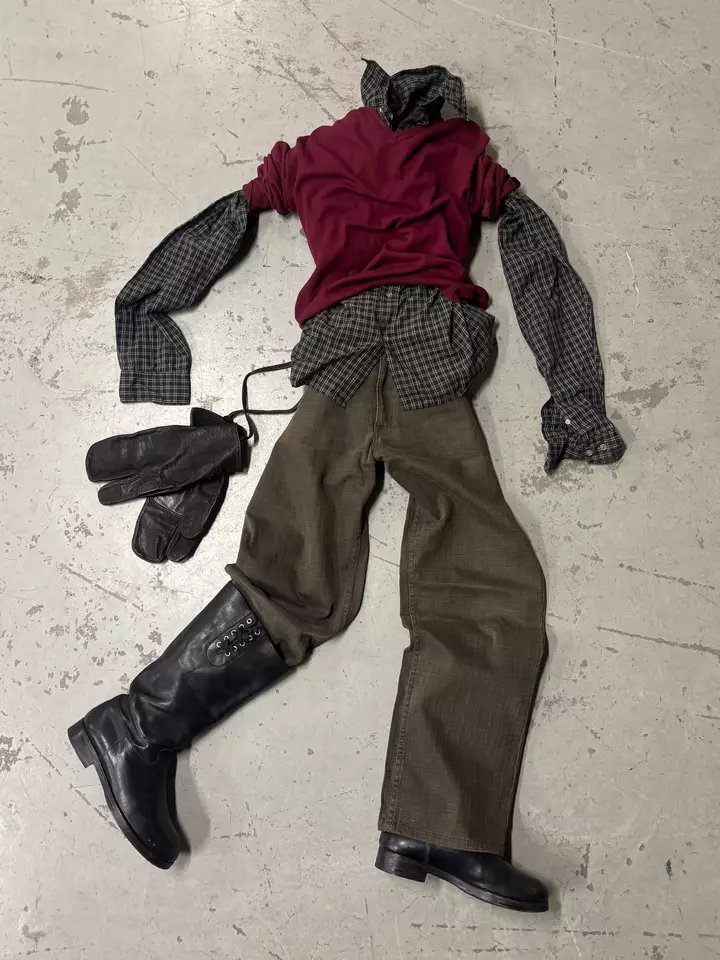
Portrait of the Absent, a new book of flat-lay photographs by Jack Jildevik might have you considering that idea. Over the course of a year the Swedish artist crafted bodiless self-portraits by documenting ensembles he arranged on the floor of a storage facility. It might be a coincidence, but the flat-lay aesthetic is creeping into (fashion) photography at the same time that Ozempic is shrinking bodies.
Not that the trend had anything to do with Jildevik adopting the format for this achingly personal project. It reveals and conceals at the same time, making something ordinary feel strangely mysterious,” observed Berlin-based graphic designer Elsa Mueller, Jildevik’s collaborator on the book and its publisher (via her new publishing house Prince). An accident broke the linearity of his career and reoriented it towards art.
I was an overly nostalgic child, always drawn to, almost obsessed with, old objects, materials, and the lives they carry. I think that fascination has followed me through everything I’ve done.” The artist himself is a ghost-like constant in the book which derives some of its power from the way it resists the centrality of the body and the narcissism that defines culture today. Jildevik’s pictures are as much portraits of garments as of himself.
This idea of a piece of clothing having status as a stand-alone object runs counter to the received wisdom that the body completes a garment. They carry memories, different periods of my life, and sometimes versions of myself that no longer exist. With Portrait of the Absent, I started taking these things out of their original context, rearranging them into new compositions and photographing them as self-portraits. … The person is absent, but in a way everything that makes the portrait personal is still there.” Almost everything—the face is usually the focal point of a portrait.
This book forces us to consider how clothing can communicate identity without the body, or gestures, or the visage, but rather through arrangement and spatial orientation. This interview has been edited and condensed for clarity. What’s your relationship with objects?
I’ve always been obsessed with collecting. Ever since I was a kid, I’ve always cherished my things a lot—not expensive things, but finding things that only I have. My parents have always been flea market and secondhand geeks, that’s all that they’re doing, and I guess that I got hooked at a very early age.
Extract — continue reading at the source.