Honeybee comb is unique among animal architectures in its strikingly regular hexagonal cells, yet how this geometry emerges remains debated. Do bees construct perfect hexagons from the outset, or does regularity arise through later adjustments? We examined comb-building dynamics by presenting honeybees (Apis mellifera) with wax stimuli that constrained cell placement and angular space.
Across three experiments, we tested predictions about how bees distribute the available angular range at cell junctions, shape cell bases, and correct irregularities over time. Initially, cells were uneven, with curved walls and variable angles. When the angular space was restricted to 180°, bees built cells with 90° internal angles; as construction progressed and barriers eroded, angles shifted toward 120°, equalizing the 360° range among three adjoining cells.
Similarly, opposed cells formed flat bases orthogonal to side walls (≈90°), contrasting with the pyramidal bases of natural comb. When separate tongues of comb merged, cells at junctions were highly irregular, but subsequent work significantly reduced disparities in wall angles and cell size. These findings reveal that honeycomb cell geometry emerges through a self-organizing process: bees iteratively redistribute space and adjust cell boundaries until equilibrium is achieved.
This dynamic optimization explains the iconic hexagonal pattern without invoking complex cognitive strategies. Honeybee comb has long been the subject of human fascination, with the first recorded analysis of its structure dating back to the ancient Greeks1. Honeycomb is characterised by both its regularity and its structural efficiency: a double-sided sheet of tessellated hexagonal cells that both minimises the wax required for construction and maximises storage capacity2,3,4.
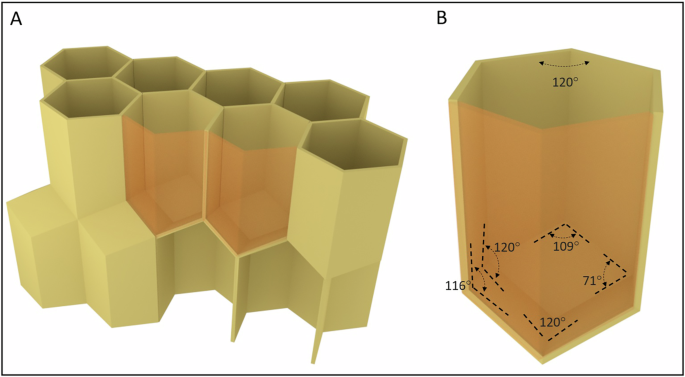
While the geometry of completed comb is well described, the process by which this geometry emerges from the construction activities of worker bees remains debated. We explore here whether comb regularity may be an emergent property arising from angular redistribution and equilibrium between the concurrent activities of builders in adjacent cells. In natural honeycomb, the hexagonal cells have pyramidal bases that interlock along a shared backplane, resulting in an offset of half a cell between the two sides (Fig. 1A).
Thus, while the hexagonal face of a sheet of comb is characterized by three-way cell intersections, with 120° wall junctions equally spaced in two dimensions around 360°, the interface between the two sides of comb involves four-way cell intersections involving a cell from one face centred at the intersection of three cells from the other. At each four-way intersection, the dihedral angles are also 120°, equally spaced around 360° in a three-dimensional layout (Fig. 1B). Workers that add new cells undertake this work based on the structures of existing cells within the comb that they have already constructed5,6,7,8,9,10,11,12.
Extract — continue reading at the source.


