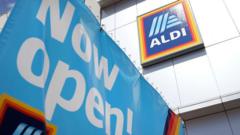
How Aldi is taking on US supermarkets with its $4 almond butter ry Porter shops at Aldi's new Manhattan location in New York City for the first time When Mary Porter walked into Manhattan's newest Aldi store hunting for bargains, the long-time resident found what she considered a retail miracle in plain sight: a $4 jar of almond butter that costs $22 in her own neighbourhood. "Aldi has the reputation for being inexpensive, so I thought I would come and check it out, and by golly, it is amazing," Porter, 79, told the BBC, marvelling at the savings alongside the fresh spinach and organic raspberries filling her basket. To the unassuming passer-by, the storefront is completely hidden, tucked away in an underground car park beneath The Ellery, a luxury apartment complex where the cheapest rent starts at nearly $5,000 (£3,725) a month.
In fact, the building's own website completely omits the grocer from its curated online neighbourhood guide, choosing instead to highlight pricier nearby options like Whole Foods and Brooklyn Fare. But step past the luxury façade into the basement, and the quiet disappears. Even on an early Tuesday afternoon in July, the brightly lit, bustling space hums with high energy as a lunchtime crowd of New Yorkers tightly navigates the narrow aisles with oversized canvas bags.Porter's discovery is part of Aldi's $9bn US expansion plan to add 800 new stores over five years, specifically targeting dense urban hubs like Manhattan.
It marks a massive scale-up for the German supermarket, which first entered the US in 1976 and has steadily grown its footprint to nearly 2,800 storefronts. The aggressive real estate blitz signals a bold shift for a brand traditionally associated with suburban strip malls and lower-end consumers. n is one of 800 new store openings Aldi has planned over five yearsIncumbent US grocers may look with some concern at the insurgency Aldi pulled off since it entered the UK market in the 1990s. Alongside fellow German supermarket Lidl, Aldi picked up huge swathes of the market by offering cheaper prices for high-quality goods.
The traditional "big four" grocers at the time - Tesco, Sainsbury's, Asda and Morrisons - were slow to respond to the new competition, leaving the challengers to gradually pick off their shoppers.Today, Aldi is the UK's fourth biggest grocer, commanding 10.8% of the market.Its rapid growth is being mirrored across Europe, its rise aided by easing perceptions of it as a strictly lower cost grocer as shoppers became increasingly impressed by the quality of its products. The cost of living crisis of the 2020s further fuelled its ascent. However, while Aldi is rapidly ascending the ranks of American grocery consciousness, it is not, and may never aim to be, Walmart.
Aldi currently holds just 2.9% of the US grocery pie, while Walmart controls about 20%.Yet analysts say that staying smaller is precisely how Aldi wins. Data from location analytics firm Placer.ai reveals Aldi is capturing middle- and higher-income shoppers with household incomes between $75,000 and $125,000. Years of persistent inflation have forced wealthier households to aggressively seek cheaper supermarkets."Those shoppers have started to trade off a visit to a conventional grocery store or a quick service restaurant and started to go into Aldi more frequently," R.J.
Hottovy, Placer.ai's head of analytical research, told the BBC. "They're looking for ways to stretch their household budget." Walmart warns US shoppers are cutting spending as higher petrol prices bitePublished21 MayFor some urban commuters, the new city location offers a better experience than older formats. Kelvin Dozier, who usually shops at an Aldi in Brooklyn, recently started visiting the Manhattan location right across from his office for convenience.
Extract — continue reading at the source.