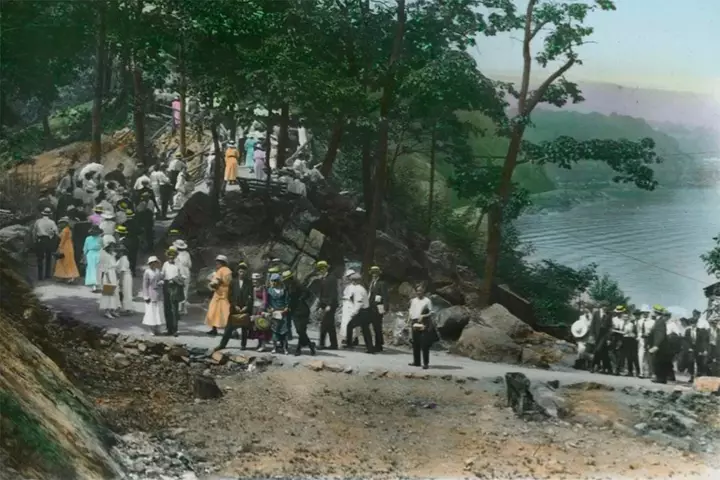
Oil is the foundation of American life, with the consumption of gasoline written into the very landscape of the nation itself. Historian Raechel Lutz argues that even our sense of nature has been shaped by “oil, oil wealth, and road technologies,” and uses Palisades Interstate Park as a prime example of how the nation’s petroleum infrastructure shaped its landscapes. Petroleum magnate John D.
Rockefeller Jr. is celebrated for his millions of dollars in land and monetary donations for the park that saved the Palisades. It is less well known that he made the forty-two-mile-long Palisades Interstate Parkway, which travels the length of the park, a condition of his largesse. The Palisades stretch north from Staten Island, New York, through Jersey City, New Jersey, to Nyack, New York.
They are most dramatic north of the George Washington Bridge, where the twenty-mile stretch of cliffs preserved as a park begins. At their tallest, they reach 540 feet above the Hudson River. One of the East Coast’s most dramatic geological features, the cliffs are named for their similarity to a palisade or defensive fence.
Local Native Americans called the cliffs the “rocks that look like trees.” Made up of a two-hundred-million-year-old igneous diabase, the Palisades proved irresistible to miners in the nineteenth century. The cliffs were mined for stone for buildings, including early skyscrapers, and roads. By the 1890s, “local citizens, conservationists, and the Federation of Women’s Clubs” demanded that New Jersey and New York create a park along the cliffs to save them from destruction.
As a result, the Palisades Interstate Park Commission was created in 1900 by the two neighboring states. But neither New Jersey nor New York would fund the commission. So the commission instead turned to people with money for the purchase of land and the termination of mining activity.
Harriman all gave major gifts of money and land. Rockefeller was the richest man on the planet; his $900 million in 1912 equaled about “$22.5 trillion in today’s money.” Rockefeller’s son, John D., Jr., who “assumed stewardship of the family’s wealth and public image” in 1921, ended up contributing substantial amounts for the protection and development of Palisades Interstate Park. Rockefeller Jr. was instrumental in the formation of other parks in the US, but the Palisades received “over half of his cumulative donations” for park landscapes.
Extract — continue reading at the source.