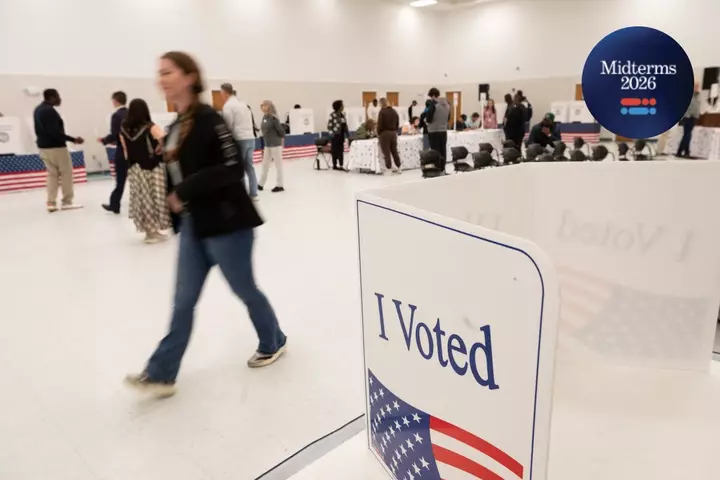
Democrats' midterm victories did not stop at the steps of the U.S. Across the country, voters handed the party control of state legislative chambers that determine everything from abortion laws and school funding to taxes, voting rules, and congressional maps. In Wisconsin, the party flipped both legislative chambers and retained the governorship, producing a unified Democratic government in the state for the first time in 16 years.
Democrats also gained control of five state governments, further expanding the party's power. "This huge blue tsunami also washed across so many state legislatures and, critically for Democrats, it gave them trifecta control. Control of both houses of the state legislature and the governor in a range of states," Thad Kousser, a professor with the University of California San Diego's Department of Political Science, told Newsweek.
"So, in Washington, D.C., Democrats have this huge mandate to make real change, but a lot of obstacles that may prevent them from doing what voters sent them to Washington to do." While not all results are finalized as of Wednesday night, Newsweek has analyzed results from the National Conference of State Legislatures (NCSL) and Ballotpedia, which showed the Wisconsin flip, along with both chambers in New Hampshire, the Pennsylvania Senate, and the Houses in Michigan, North Carolina, Texas, and Minnesota. In Georgia and Arizona, results were still not finalized at the time of writing, but both states looked set to see Democrats take control of their lower chambers, while other states were yet to declare or saw no shift. "Even with Democratic majorities in the House and Senate, Congress still faces a presidential veto, so the most likely result in Washington is gridlock," Boris Shor, an associate professor at Houston University's Department of Political Science, told Newsweek.
"In the states, Democrats now hold unified control in more places and can pass laws." Heather Williams, president of the Democratic Legislative Campaign Committee (DLCC), told Newsweek that 2026 would go down as one of the greatest political landscape shifts in American history. "Now more than half the country lives in a state with a Democratic state legislature," Williams said. "Our wins this year build on a decade of progress and will have some of the biggest and longest-lasting impacts of this election for the Democratic Party and for our country.
"The DLCC and our legislators are ready to fight through the challenges of the final two years of the Trump administration to continue delivering for millions of Americans and building power through 2027’s elections and into 2028’s presidential race." Newsweek also reached out to the Republican State Leadership Committee for comment via voicemail Wednesday. While Congress tackles issues such as immigration law, defense, nationwide regulations, and federal health programs, state legislatures govern many other policy areas, including how federal funds are spent on services such as health care and schools. "The Democratic gains in state houses are important because state legislatures do much of the policymaking in this country.
For instance, for every law Congress passes, each state legislature passes two," Steven Rogers, a political science professor at Saint Louis University, told Newsweek. "State governments are largely responsible for most education spending and have significant influence over transportation (e.g., roads) in states. "Democratic legislatures will also be more likely to restrict data centers for environmental reasons, which is becoming a hot-button issue." Shor explained that so-called trifectas were the thing to watch, as with control of the governor's office and both chambers, a party can more easily pass budgets and change policies on Medicaid, K-12 funding, housing, and zoning.
Extract — continue reading at the source.

