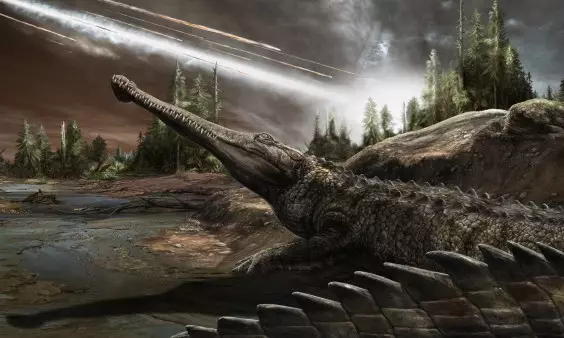
Dinosaurs and crocodilians popped up around the same time roughly 245 million years ago, but only one group survived the asteroid impact 65 million years ago (avian dinosaurs, aside). According to a new study published in Science Advances, the secret of crocodile success boils down to three things: location, location, location. A team of researchers led by paleontologists from University College London examined over 7,000 fossils and records belonging to more than 400 species (living and dead) from pseudosuchia, a larger group that includes crocodilians.
They then compared the records to computer models reconstructing Earth’s changing climate over the past 245 million years to map out the global history of the group across space and time. Read more: “This Ancient Crocodile Ancestor Learned to Walk on Two Legs” With a couple notable exceptions, the team found that crocodiles survived by moving to warmer climes. When Earth’s temperature was around 18 degrees Fahrenheit warmer as recently as 50 million years ago, the reptiles ranged as far north as Europe and Antarctica.
After a period of global cooling, they retreated to the tropics, where they thrive today. The researchers also focused on how climatic changes immediately after the asteroid impact may have affected crocodilians. Using models to simulate the chilly temperatures resulting from sunlight-blocking clouds of dust, the team tested a few different scenarios.
With sunlight dimmed by five or ten percent, crocodiles still prospered in equatorial regions, they found, but turning the dimmer switch down to 15 percent proved to be too chilly for the cold-blooded reptiles. Earth was once home to a panoply of pseudosuchian diversity—there were long-legged terrestrial crocs, massive 40-foot long “super crocs,” even pug-nosed armored vegetarian crocs. Compared to crocodilian boom times, there are relatively few species left.
Still, that’s obviously a lot more than non-avian dinosaurs. Subscribe to our free newsletter.
Extract — continue reading at the source.