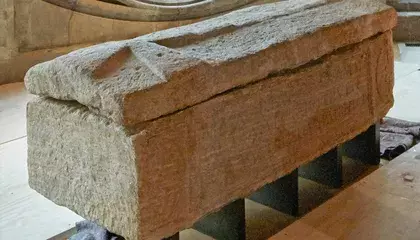
When Arthur Penrhyn Stanley, the dean of Westminster Abbey, returned home after an 1869 trip to Italy, he was surprised to learn that in his absence, workers at the centuries-old London church had stumbled upon a limestone sarcophagus “belonging to the same epoch and nation as the great city which I had just quitted.” The find presented a mystifying puzzle: How did a seemingly ancient coffin end up in a medieval abbey? And whose body was buried inside it? Stanley detailed his study of the sarcophagus in an 1870 journal article.
Although the coffin bore a Latin inscription apparently dated to the Roman occupation of Britain, its lid featured a large cross that was more consistent with the early medieval period, hundreds of years later. As the dean wrote, “There was nothing to indicate the rank of the person, nor in fact anything but the skeleton, with the exception of a few fragments of brick, apparently Roman brick, and a piece of dark gray, slag-like substance.” Still, Stanley concluded that the skeleton itself likely wasn’t Roman, instead dating to a later era. In the century and a half since the coffin was first excavated, scholars have offered varying explanations for its presence in the abbey, where only a few other Roman artifacts have been found.
Now, archaeologist and architectural historian Warwick Rodwell has seemingly solved the mystery, drawing on radiocarbon dating and a skeletal analysis conducted by colleague James Langthorne to identify the sarcophagus’ occupant. In a paper published in the Journal of the British Archaeological Association, Rodwell argues that the skeleton likely belongs to Aelfwig, a monk who served as Westminster’s abbot (equivalent to a dean) prior to his death around 1020. Another possible candidate is Aelfwig’s successor, Wulfnoth.
But either would fit equally well if we assume the abbot was in his early 20s when the appointment was made and close to 50 when he died.” (Langthorne’s assessment identified the skeleton as a roughly 5-foot-9, 35- to 49-year-old man, contradicting earlier analyses that suggested he was slightly shorter and no older than 30.) Stanley and his contemporaries looked to an inscription on the coffin for insights regarding its original owner. Translated into English, the message reads, “To the memory of Valerius Amandinus. Valerius Superventor and [Valerius] Marcellus made [this] for [their] father.” Based in part on this eulogy, Victorian scholars dated the sarcophagus to between the second and fifth centuries.
Rodwell, for his part, agrees with a theory put forth by Martin Henig, an archaeologist at the University of Oxford. As Rodwell notes in the paper, Henig argued that the coffin “was a Christian burial, probably of the Constantinian era,” in the early fourth century. Although the inscription’s “high quality” implies that Amandinus was “a significant figure in Roman London … nothing is known about his career,” Rodwell adds.
Famous faces at Westminster Abbey As for the coffin’s Roman origins, Rodwell notes that ancient sarcophagi were sometimes reused centuries after their initial interment. The English monk Bede, for instance, wrote that the body of the seventh-century saint Elethdreda was buried in a “white marble coffin, most beautifully wrought,” that was found “near the city walls” of Grantacaestir, a Roman town near Cambridge, and brought back to the monastery where she’d served as abbess. Rodwell tells the Guardian’s Nicola Davis that Westminster “was not [the coffin’s] original place of burial.” Instead, he suggests that the sarcophagus was taken from the wall recess of a mausoleum located elsewhere—a theory that would account for the absence of decorations on all but one of its sides.
Extract — continue reading at the source.