For years, mainstream media have parroted the language of their own governments, and that of lsrael, with little critical coverage of or challenge to the dominant political narrative in the West. Palestinians have been systematically dehumanized, along with the broader Arab and Muslim world, to serve the foreign policy objectives of governments without questioning the moral and legal implications. The horrors that have been normalized in Gaza are the culmination of this long history of racism and injustice.
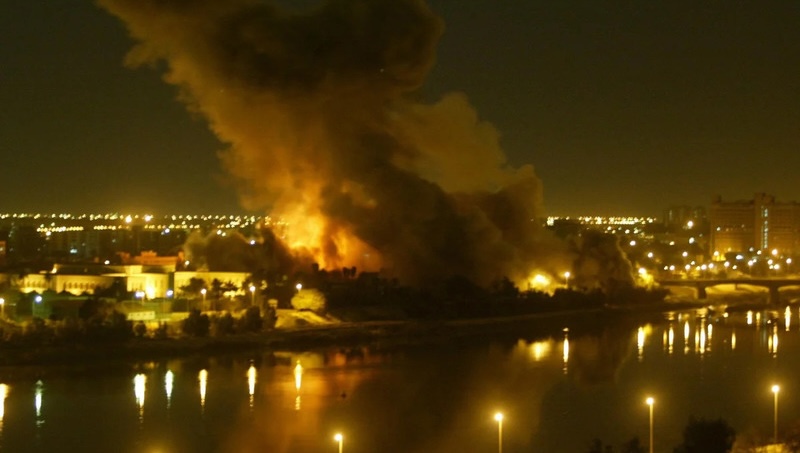
But it is not the first time in recent memory that the media have played a central role in legitimizing war crimes. It is often said that hindsight is twenty-twenty—a phrase that suggests we are better equipped to judge past events once their consequences have come to light. This could not be truer than in the case of the 2003 U.S. invasion of Iraq.
More than two decades after the incursion that claimed so many Iraqi lives, wrought havoc on the region, and sowed the seeds of ongoing conflict, there is now a clear consensus among analysts and the American public that the war was a catastrophic foreign policy mistake. Launched under the guise of national security, framed as a righteous mission to rid the region of WMDs and to liberate the Iraqi people from Saddam Hussein—whom the United States had supported as early as the 195os and in the 1980s during his war of aggression against Iran—the invasion stands today as a textbook case of how deceit, racism, and empire were packaged for popular consumption, with the U.S. media serving as willing accomplices. Rather than holding power to account, media figures and institutions were complicit in shaping public opinion to support the war.
But while hindsight may offer clarity, the warnings were there from the start. Experts, scholars, and millions of protesters around the world questioned the Bush administration’s push for war in Iraq and the expanding “war on terror.” They demanded evidence for the WMD claims, called out anti-Arab and anti-Muslim fearmongering used to demonize Iraq, and highlighted the likely humanitarian and geopolitical consequences of launching a preemptive war. These voices, however, were largely drowned out, while the loudest platforms were reserved for government officials and pundits making a case for war.
In September 2002, the former Israeli prime minister Benjamin Netanyahu testified in front of the U.S. Congress that Saddam Hussein was aggressively developing WMDs, advocated for preemptive U.S. strikes in Iraq, and made his now-infamous claim, “If you take out Saddam, Saddam’s regime, I guarantee you that it will have enormous positive reverberations on the region.” Just a few months later, in February 2003—a month before the invasion—Secretary of State Colin Powell presented a dramatic case to the United Nations, citing mobile weapons labs and hidden stockpiles of WMDs as justification for war. Despite internal dissent within the intelligence community and a glaring lack of hard evidence, the media did little to challenge these claims.
After the invasion was already under way in July 2003, the British prime minister, Tony Blair, continued to insist that there was “absolutely no doubt at all that we will find evidence of weapons of mass destruction programmes.” Powell’s statements, along with Netanyahu’s and Blair’s, were later exposed as false, something Powell himself would admit years later, but the damage had already been done. Iraq was invaded, the lives of ordinary Iraqis were shattered, and no weapons were ever found. Nearly 4,500 U.S. troops were killed in Iraq, as well as 179 British service members, while hundreds of thousands of Iraqis were killed either directly or indirectly as a result of the war, and millions more were displaced.
Extract — continue reading at the source.