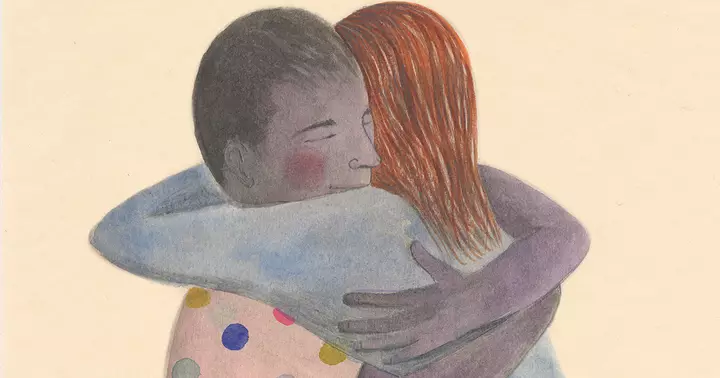
Tolkien believed, is “as necessary for the health and complete functioning of the Human as is sunlight for physical life.” But enchantment is a story we tell ourselves that tells us back to ourselves, and like every story, it can be true or false. Love is the most powerful enchantment we know, the most transformative if true and the most dangerous if false. Auden observed in one of the most insightful things I have ever read, adding the haunting admonition: “All true enchantments fade in time… A false enchantment can all too easily last a lifetime.” False enchantments are those we cast upon ourselves — by confusing love and longing, by mistaking the myths of our culture for our own truths, by replaying the patterns that keep breaking our hearts.
True enchantments come unbidden, take us by surprise, defy wish and will. True love, then, is a kind of enlightened enchantment — haunted, yes, by the fundament of loss, but redeemed by how it sharpens and magnifies our contact with life, how it allows us, paradoxically, to touch the bare skin of reality and tremble with bewilderment that such a wonder is possible. In Art and Enchantment: How Wonder Works (public library), anthropologist and ecological philosopher Patrick Curry offers a field guide to the difficult discernment of the true from the false, treating love as both a special case of and a fulcrum for our arts, both love and art being a way of “adding to, while partaking of, the creative processes of life itself.” In a sentiment that conjures up that lovely line from The Velveteen Rabbit — “Real isn’t how you are made… It’s a thing that happens to you.” — he writes: Enchantment is not something you do; it’s something that happens to you.
Its opposite is thus will and all its relations… When and where you are trying to make something happen, or make someone (including yourself) do something — or when you are the object of those desires — enchantment is absent. It is absent because then you are in projection, in a transactional paradigm, exerting an effort in order to be repaid by a desired end. Curry writes: Enchantment is fundamentally relational.
It is wonder at, or enchantment by, another… Apprehending the enchanting other, one is apprehended by them. The other party in this process can be anyone or anything: a human being, another animal, a plant, a place, a sight, sound, smell, taste, texture, or even an idea. But we are a particular kind of being — not random, infinitely variable or, in that self-flattering delusion, universal – so enchantment tends to happen in certain domains: principally love, art, religion, food and drink, learning, sport, humour, and nature.
Paradoxically, the engine of enchantment is not similarity but complementarity, which implies difference. It is the hand that touches another across the abyss between us. A generation after Mary Oliver contemplated how differences bring couples closer together, Curry observes: Enchanted relationship takes place as an encounter, typically across a gap of difference.
The boundaries remain, but in being bridged they cease to matter… transcended in connection. When that happens, you are in enchantment’s realm: the more-than-human, which includes but also exceeds the human. However, friendship — less showy than erotic love — can run just as deep, and is often more enduring.
Extract — continue reading at the source.