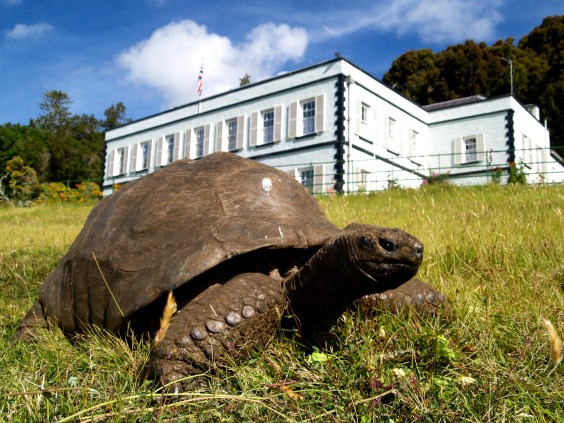
In 1882, four Aldabra giant tortoises were captured by British officials in the Seychelles and loaded onto a ship, which then traveled nearly 3,000 nautical miles to the British colony of St. The tortoises (Aldabrachelys gigantea) were gifted to Sir William Grey-Wilson, the governor of St. Helena Island, to live on the grounds of his home.
While Grey-Wilson died a century ago, one of the tortoises, “Jonathan,” is still alive. Based on Jonathan’s size when he arrived in St. Helena, he was already 50 years old, making him now 194 years old.
And Jonathan is a gift that keeps on giving. Read more: “The Tortoises That Inspired Modern Robotics” A new study of his genes and associated chemical switches (the epigenome) has illuminated how giant tortoises achieve such unparalleled longevity. Led by U.S. geneticists and published today in Science Advances, the study put forth a model for tortoise age-resistance that entails a positive feedback loop between DNA repair, ATP production, and other key cellular activities.
The research team sequenced Jonathan’s genome from cheek swags and saliva and assayed his methylome, a signature that shows how the genome has been epigenetically modified by the environment. They found a whopping 287 unique gene variants that limit the effects of aging by repairing DNA, stemming inflammation, regulating insulin, and suppressing cancer. They also found that the epigenetic switches turning the genes on and off were akin to those of younger Aldabra tortoises.
In humans, our epigenome changes over time, leading to degradation of our bodies as anti-aging genes shut off. In contrast, Jonathan still has all his anti-aging tools at work in his nearly 200-year-old body. Jonathan might look old, but don’t let that fool you—he still has plenty of spring in his step and, most importantly, vigor in his cells.
Subscribe to our free newsletter.
Extract — continue reading at the source.



/https://tf-cmsv2-smithsonianmag-media.s3.amazonaws.com/filer_public/55/9c/559c3e43-f760-48c8-978b-1faec1bf964e/nobel-chem.jpg)